







Written by
Annie Laukaitis04/09/2026
Key highlights:
B2B furniture ecommerce brings complex trade buying online, giving dealers, designers, and procurement teams easier ways to research, quote, order, and reorder.
B2B and B2C furniture sales require different experiences. Trade buyers often need negotiated pricing, company accounts, purchase orders, net terms, and bulk-ordering capabilities.
The right B2B ecommerce features simplify complex furniture sales, from product configuration and customer-specific pricing to digital quoting, procurement integrations, and buyer portals.
Furniture fulfilment requires specialised workflows. LTL freight, dimensional weight, delivery tiers, damage claims, and white-glove service all need to factor into the digital buying experience.
Furniture businesses can add B2B without starting over. Hybrid sellers can use shared catalogues, segmented pricing, ERP integrations, and tailored trade experiences to serve B2B and B2C buyers from the same ecommerce ecosystem.
Big orders, bigger expectations
Picture an interior designer sourcing 40 chairs for a hotel renovation. They’ve found the perfect style, but before they can place the order, they need trade pricing, finish options, lead times, and a quote.
Getting those answers used to mean calls, emails, and plenty of back-and-forth. Today, buyers expect a faster path from “this could work” to “order placed.” Dealers, interior designers, and procurement teams want to research products, compare options, request quotes, place orders, and reorder online — while still getting the personalised pricing and service that come with a B2B relationship.
B2B furniture ecommerce brings those traditionally complex interactions into a more convenient digital experience. It gives manufacturers, wholesalers, distributors, and hybrid B2B/B2C retailers a way to serve business buyers online without stripping away the flexibility that furniture sales require.
The showroom isn’t disappearing. It just has a digital front door now.
What is B2B furniture ecommerce?
B2B furniture ecommerce covers furniture sold online for commercial use, client projects, or resale. Depending on the purchase, B2B furniture buyers can include:
Retail dealers stocking showrooms or replenishing inventory
Interior designers and architects sourcing furniture for client projects
Hospitality buyers furnishing hotels, restaurants, and other commercial spaces
Procurement teams purchasing furniture for offices and large-scale projects
That means the buying experience needs to work differently, too.
Rather than simply displaying products with a standard checkout, B2B furniture ecommerce can support trade pricing, quotes, purchase orders, made-to-order products, and customer-specific accounts. A manufacturer, for example, might give an approved dealer access to wholesale pricing that isn’t available to the public.
Where those transactions happen also matters. Wholesale marketplaces connect sellers with buyers through a third-party platform. An owned B2B storefront gives furniture businesses greater control over their catalog, pricing, customer relationships, and overall buying experience.
For hybrid retailers, one storefront can serve consumers and trade buyers alike — while giving each audience the pricing and purchasing experience they need.
How B2B furniture ecommerce differs from B2C
Buying a dining table for your home might take a few clicks. Buying 50 tables for a restaurant? That’s a different kind of checkout.
Selling furniture B2B involves larger orders, negotiated pricing, multiple decision-makers, and more complex payment terms than B2C sales. B2C shoppers typically buy at a listed price for themselves, while trade buyers purchase on behalf of a business and may need a quote, purchase order, or net terms before moving forward.
At a glance:
B2B: Larger orders, negotiated or tiered pricing, account-specific terms, and repeat purchasing
B2C: Smaller orders, listed prices, immediate payment, and individual purchasing decisions
Hybrid B2B/B2C: One catalogue serving both audiences with pricing and experiences tailored to each buyer
Order size, pricing, and negotiation.
Furniture orders can add up quickly. Dealers may purchase inventory in bulk, while interior designers might specify dozens of pieces for a single project.
Instead of showing every buyer the same price, B2B sellers can offer customer-specific pricing, volume pricing, and negotiated quotes. That flexibility can help businesses protect margins while rewarding high-value trade relationships.
Buying committees and longer sales cycles.
A B2C shopper can see a sofa, love it, and buy it.
B2B furniture sales often involve more people and more steps. Designers, procurement teams, project managers, and finance teams may all weigh in before an order is approved. The process can stretch from initial product research and configuration to a quote, purchase order, and final payment terms.
Running B2B and B2C from one storefront.
Hybrid sellers don’t necessarily need two separate ecommerce stores.
A shared catalogue can support both audiences, while customer accounts determine which products, prices, and purchasing options each buyer sees. Consumers get a familiar retail experience, while approved trade buyers can log in for wholesale pricing and B2B purchasing tools.
One storefront. Two very different buying journeys.
Why furniture brands are investing in B2B ecommerce in 2026
Furniture has always been big business. Increasingly, that business is happening online.
The global B2B ecommerce market will reach $28 trillion in 2026, up from $24.1 trillion in 2025. Grand View Research projects the market will grow at a 20.9% compound annual growth rate through 2033.
Furniture is moving online alongside it. The global online furniture market will grow from $131.4 billion in 2025 to $139.5 billion in 2026, according to Mordor Intelligence. By 2031, the market will reach $202.33 billion.
And B2B buyers aren’t simply browsing online. They’re transacting there. U.S. B2B ecommerce grew 13% to $2.93 trillion, with more than 90% of B2B transactions now happening electronically, according to Digital Commerce 360’s 2026 market forecast.
For furniture manufacturers, wholesalers, and distributors, those shifts create a compelling opportunity. Furniture’s high average order value (AOV), repeat trade purchases, and increasingly digital procurement processes are well suited to ecommerce.
The opportunity goes beyond moving existing B2B furniture sales online. A strong digital channel can make it easier for trade buyers to research products, place larger orders, and come back when it’s time to restock.
The biggest challenges of selling furniture B2B online
The biggest challenges of selling furniture B2B come from translating complex, relationship-driven workflows into a digital experience that works at scale.
Managing complex catalogues and made-to-order SKUs.
Complex catalogues can turn a single product into hundreds of SKUs. A sofa might come in dozens of fabrics, finishes, sizes, and configurations — with some combinations made to order. A strong product configurator can simplify those choices while helping buyers understand exactly what they’re ordering.
Navigating furniture freight and damage risk.
Furniture freight gets complicated — and expensive — fast. Bulky casegoods, multi-box shipments, and fragile pieces introduce considerations such as dimensional weight, freight class, and damage risk. Sellers need shipping workflows that account for these variables instead of treating a dining table like a standard parcel.
Supporting longer, more complex buying cycles.
B2B furniture sales rarely follow a straight line from product page to checkout. A designer may specify products months before a purchase order arrives, while procurement and finance teams may need to approve the project along the way. Digital quote workflows, customer accounts, and saved orders can keep that longer buying cycle moving.
Managing channel conflict with dealers and sales reps.
Going digital can create channel conflict with dealers and sales reps. Manufacturers selling directly online need to avoid undercutting the partners that helped build their business.
Customer-specific pricing, gated catalogues, and clearly defined account ownership can preserve those relationships while giving dealers and other trade buyers more self-service options.
These challenges don’t mean complex furniture sales should stay offline. They mean the digital experience has to be built around how B2B furniture buying actually works.
Must-have B2B ecommerce features for furniture sellers
A furniture wholesale platform needs to do more than process a large cart. It should support the pricing, approvals, quoting, payment terms, and buyer relationships that happen behind every B2B furniture order.
Here are the B2B ecommerce features that matter most.
Company accounts and buyer roles.
Company accounts let multiple buyers purchase on behalf of the same business while maintaining their own roles and permissions. That matters when a dealer, design firm, or hospitality group has several people involved in purchasing.
With BigCommerce B2B Edition, businesses can create company accounts and define buyer roles, helping the right people access the right purchasing capabilities through a self-service portal.
Customer-specific price lists and volume pricing.
B2B buyers rarely all pay the same price. Customer-specific price lists and tiered pricing let sellers tailor prices based on the account, quantity purchased, or commercial relationship.
A dealer buying 50 dining chairs, for example, might receive different volume pricing than an interior designer ordering five. Logged-in buyers can see the pricing that applies to them without contacting a sales rep for every order.
Quote and RFP management.
Digital quoting turns a traditionally email-heavy process into a structured path from request to order.
A buyer can build a cart and submit an RFQ, a sales rep can review the request and adjust pricing or terms, and the approved quote can become an order. For large or made-to-order furniture projects, that creates a smoother experience without removing negotiation from the equation.
Net terms, credit, and purchase-order checkout.
Net terms give approved B2B buyers time to pay after an order is placed. Alongside credit limits and purchase-order checkout, they let established customers buy through the payment workflows their businesses already use.
That can be especially important for high-value furniture orders where paying the full balance by credit card isn’t practical.
BigCommerce is also exploring how AI can simplify these workflows. Currently in closed beta, the B2B Purchase Order Agent helps automate purchase-order submission, validation, and order completion — reducing manual back-and-forth while making purchasing faster and more accurate for B2B buyers.
Punchout and procurement integration.
Punchout connects an ecommerce catalogue directly with a buyer’s procurement system. Buyers can access an approved catalog, build an order, and return the cart to their procurement platform for internal approval.
For larger hospitality, corporate, and contract furniture accounts, punchout can reduce manual entry while fitting ecommerce into existing purchasing processes.
Dealer and sales-rep portals.
A buyer portal gives dealers and trade buyers a central place to manage their B2B relationship online. Depending on the setup, they can view account pricing, access order history, reorder products, manage quotes, and check account information.
Sales reps can spend less time handling routine requests and more time supporting complex projects — giving buyers more independence without taking the relationship out of the sale.
No two furniture businesses have exactly the same B2B workflows. Thankfully, B2B ecommerce platforms like BigCommerce offer the flexibility to tailor the buying experience to different customers, sales processes, and business needs — even as they change over time.

Freight, LTL, and white-glove delivery for B2B furniture orders
A box of throw pillows is one thing. A 12-piece sectional headed to a hotel lobby is another.
For B2B furniture sellers, shipping is part of the buying experience — and the economics of the sale. Order size, destination, packaging, and delivery requirements can all change the final cost.
Quoting dimensional and LTL freight at checkout.
Less-than-truckload (LTL) freight transports shipments that take up only part of a truck rather than requiring an entire trailer. It’s common for B2B furniture orders that are too large or heavy for standard parcel shipping.
Rates can depend on factors such as distance, freight class, dimensional weight, and the number of pallets or cartons. Sellers may offer real-time LTL rates at checkout, use negotiated rates, or build freight into a quote.
For unusually large or complex orders, gating shipping behind a quote can make more sense than displaying a rate that may not reflect the final shipment.
Delivery tiers: dock, threshold, and white-glove.
Not every sofa needs the red-carpet treatment. Giving B2B furniture buyers clear delivery options helps match the service level to the order:
Dock delivery: Delivers freight to a loading dock, making it a practical choice for dealers and warehouses equipped to receive large shipments.
Threshold delivery: Brings an order to the first dry area of the destination without placement or installation.
White-glove delivery: Provides a higher-touch service that can include inside delivery, placement, assembly, and packaging removal.
White-glove delivery can be particularly valuable for interior designers, hospitality projects, and commercial installations where the final placement matters as much as getting the furniture through the door.
Damage, returns, and claims at wholesale scale.
More pieces and cartons create more opportunities for something to go wrong.
B2B sellers need clear processes for inspecting deliveries, documenting damage, handling damage claims, and coordinating replacements or returns across large orders. ERP integration can also keep inventory, fulfilment status, and lead times aligned, helping buyers receive more reliable delivery expectations from order through arrival.
How to add a B2B channel to an existing furniture store
Already selling furniture online? Adding B2B doesn’t have to mean building another store from scratch.
For many hybrid B2B/B2C businesses, the smarter approach is to build trade experiences around the catalogue and operations they already have. Here’s how to get started.
Segment your trade buyers: Start by identifying who buys from you and how their needs differ. Dealers, interior designers, distributors, and hospitality buyers may each require different pricing, payment terms, or ordering permissions.
Build customer groups and price lists: Give approved accounts access to the wholesale or tiered pricing that applies to them. This creates a personalised buying experience without exposing trade pricing to B2C shoppers.
Create a furniture trade programme: Set up an application and approval process that lets qualified buyers request a trade account. Once approved, buyers can log in to access relevant pricing, products, and purchasing options.
Connect your back-office systems: ERP integration can keep inventory, customer data, order information, and lead times synchronised as B2B furniture sales grow. Freight workflows should also connect with the storefront so buyers receive accurate shipping options or know when they need to request a quote.
Soft-launch with existing accounts: Invite a small group of established customers to test the experience before rolling it out widely. Their feedback can uncover friction in everything from bulk ordering to checkout.
Measure what buyers do next: Track metrics such as reorder rate and average order value (AOV) to understand whether the digital channel is making purchasing easier and increasing account value.
For most hybrid sellers, one catalogue with segmented B2B experiences can serve both consumers and trade buyers. BigCommerce Multi-Storefront can become useful when distinct dealer brands, regions, or customer experiences warrant separate storefronts.
The goal isn’t to reinvent the furniture business. It’s to make the B2B side easier to buy from.
B2B furniture ecommerce examples
The best B2B furniture ecommerce experiences don’t all look alike. These brands show how furniture businesses can use BigCommerce to support trade buyers, expand into new markets, connect complex operations, and run B2B alongside B2C.
Lekker Home.
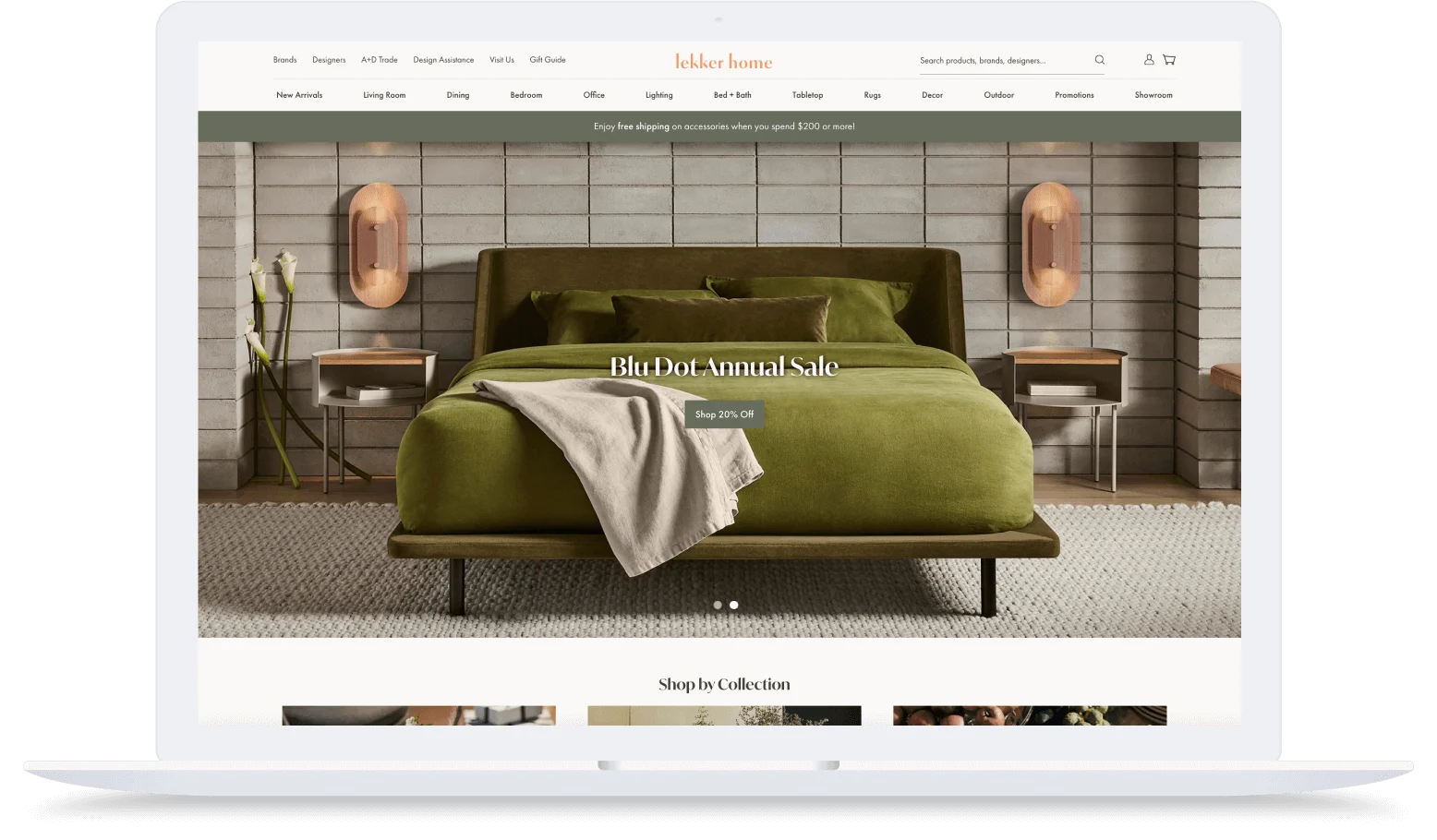
Lekker Home transformed its B2B operations with BigCommerce B2B Edition while connecting its ecommerce experience to Acumatica.
The luxury furniture retailer needed more than a consumer-focused storefront. Its B2B business required workflows that could better serve interior designers and other trade customers while keeping ecommerce and back-office data connected.
With B2B Edition and an Acumatica integration, Lekker Home created a more unified operation while giving B2B customers a faster, more efficient experience.
“B2B Edition has been a game-changer. Clients can access the A+D Trade Portal to manage quotes, pricing, and orders on their own time, which has freed up our sales team to focus on service and new business.”
— Curt Carpenter, Co-Founder, Lekker Home
Wovenbyrd.
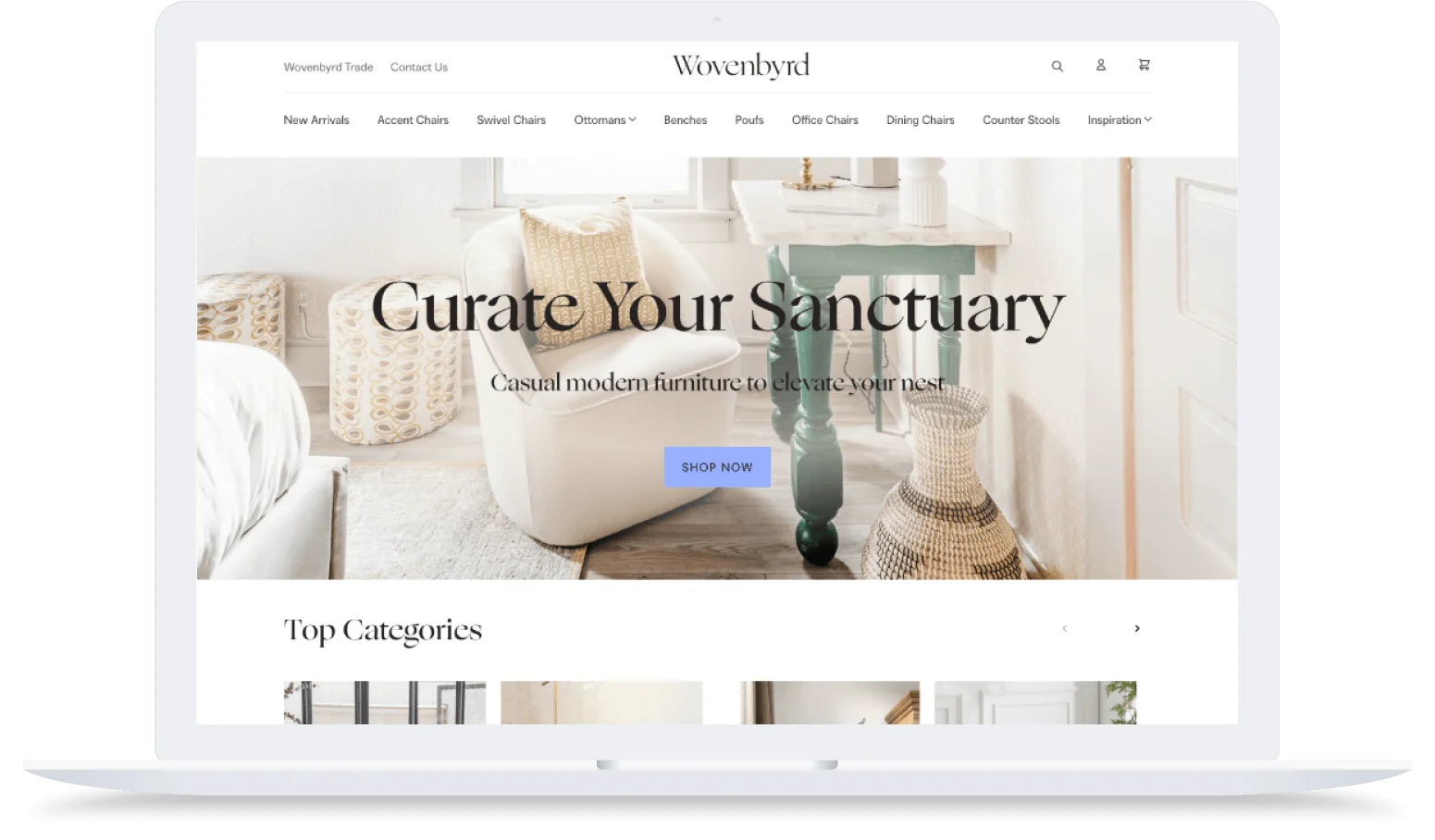
Wovenbyrd used BigCommerce to expand beyond its marketplace roots and build a stronger direct ecommerce channel.
The furniture brand wanted greater control over its digital presence as it expanded into new markets. BigCommerce gave its team the flexibility to build a branded storefront, connect its operations, and create a foundation that could support future growth.
That matters for manufacturers building hybrid B2B/B2C strategies: owning the storefront creates more control over customer relationships and how the brand goes to market.
“With BigCommerce, I have peace of mind. I know we’re positioned for growth on a platform that can support all the things we want to do over time.”
— Ty Baucum, President and CEO, Wovenbyrd
Coco Republic.

Coco Republic uses BigCommerce B2B Edition to serve trade customers alongside its consumer business.
For the luxury furniture retailer, trade buyers are a distinct audience with different needs. B2B Edition gives Coco Republic more flexibility to serve those customers digitally while maintaining the premium experience expected from its brand.
The result is a hybrid model where B2B functionality doesn’t have to come at the expense of B2C experience.
“In home furnishings, our B2B customers are digitally native, and they're excited about the opportunity to have access to tools that allow them to do what they need to do for designing and servicing their customers.”
— Jack Kiefer, Global Chief Information Officer and Chief Technology Officer, Coco Republic
Inhaven.
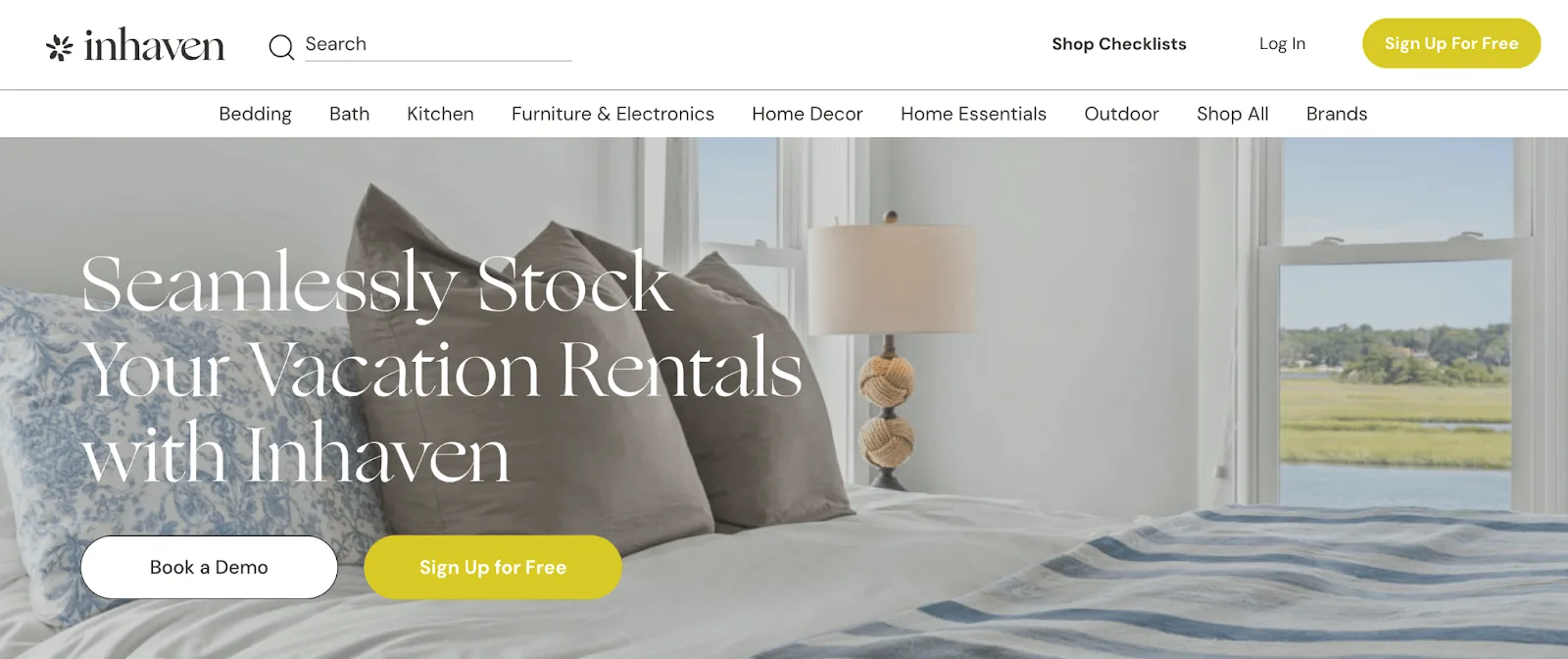
Inhaven built its B2B business on BigCommerce from the start, using the platform to support a rapidly growing hospitality brand.
The vacation-rental furnishings company needed to manage thousands of SKUs while serving professional buyers with needs that differ from traditional consumers. BigCommerce gave Inhaven access to B2B capabilities and integrations without requiring its team to build every workflow from scratch.
That foundation also gives the brand room to evolve its B2B experience as its customer base grows.
“We needed to set up customer accounts at the company level to allow multiple users with different access levels. We also needed the functionality to build tiered pricing by volume quotes. BigCommerce had all of the B2B features that I needed to quickly launch the site.”
— Ashley Ching, Founder and CEO, Inhaven
The final word
The next move for B2B furniture ecommerce doesn’t have to be a complete overhaul. Start with the parts of the buying experience that create the most friction for your trade customers.
Below are three practical places to begin:
Audit your trade-buyer experience: Look for gaps in account pricing, quoting, net terms, product configuration, and self-service ordering.
Test volume pricing on a flagship collection: Give a group of existing dealers or trade buyers an easier way to purchase in bulk and see how they respond.
Pilot online quoting with key wholesale accounts: Move a familiar sales workflow online, gather feedback, and refine it before expanding to more customers.
The right B2B ecommerce platform can make these experiences easier to manage as order volume, catalogues, and customer relationships grow. Explore how BigCommerce supports B2B businesses looking to bring complex sales online — without making the buying experience feel complex.
B2B furniture ecommerce FAQs
B2B furniture ecommerce is the online sale of furniture between businesses, such as manufacturers, distributors, dealers, and trade buyers. Unlike consumer ecommerce, it supports workflows common to B2B furniture sales, including negotiated pricing, quotes, bulk orders, and account-specific purchasing.
A furniture wholesale platform may also provide company accounts and a self-service portal so approved buyers can manage routine purchases online.
B2B orders tend to be larger and more complex, with negotiated or volume pricing, purchase orders, net terms, and longer buying cycles. Trade buyers may also need to select finishes, fabrics, dimensions, and other options through a product configurator before requesting a quote.
For businesses that sell furniture wholesale, a B2B ecommerce platform can bring these workflows online while preserving customer-specific pricing and relationships.
Yes. A hybrid B2B/B2C store can serve consumers and trade buyers from a shared catalogue while tailoring pricing, products, and purchasing options to each audience. For example, approved company accounts can unlock wholesale pricing and a self-service portal after login while consumers continue to see standard retail pricing. This approach can make wholesale furniture ecommerce easier to manage without requiring a completely separate storefront.
Net terms allow approved B2B buyers to place an order and pay within an agreed period, while purchase orders provide a record businesses can use for approval, purchasing, and payment. A B2B ecommerce platform can incorporate these options into checkout, making repeat purchasing more convenient for established trade buyers without forcing every transaction through a credit card.
Bulky B2B furniture orders commonly require LTL freight or specialised delivery rather than standard parcel shipping. Sellers may calculate freight based on shipment characteristics or provide a custom quote when an order is too complex for an accurate checkout rate. A connected B2B ecommerce platform can also help keep shipping, inventory, and order information aligned as wholesale order volume grows.
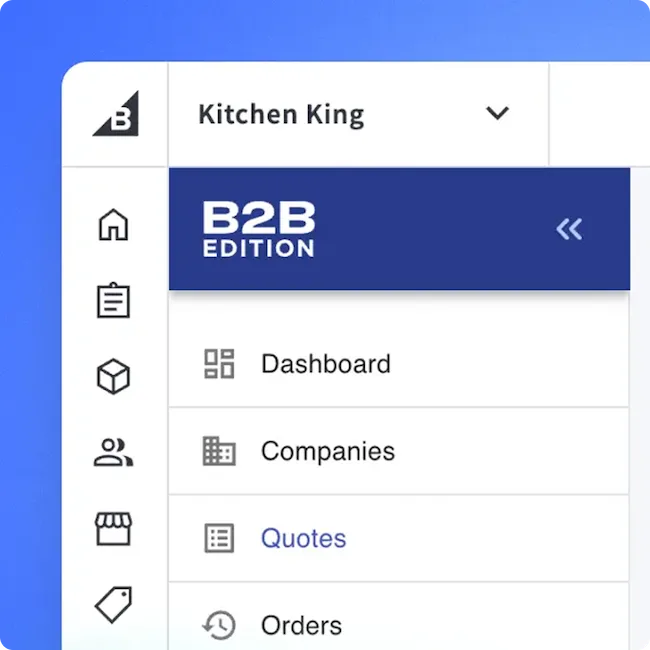
We're serious about B2B.
BigCommerce B2B Edition gives you account management and quoting tools to help your sales team get more orders.