






Written by
John Shieldsmith20/05/2026

Ecommerce Merchandising
Get The Print Version
Tired of scrolling? Download a PDF version for easier offline reading and sharing with coworkers.
A link to download the PDF will arrive in your inbox shortly.
Key highlights:
Ecommerce merchandising is a series of tactics that drive product sales across marketplaces, social media, and other channels.
You can improve ecommerce merchandising with several strategies, including catalogue curation, the inclusion of product videos and social proof, improving on-site search, and maintaining a strong brand voice.
Modern AI makes it possible to deliver accurate, real-time personalisation within merchandising across channels.
You can measure ecommerce merchandising success by tracking conversions, cart abandonment, average order value, and more.
There are several merchandising pitfalls, including lacklustre navigation, poor personalisation, and inaccurate product recommendations.
Everyone has a shelf haunted by random purchases they had no intention of getting, yet now cherish. How many of those purchases would have never happened were it not for great merchandising?
Ecommerce merchandising allows you to work a similar magic across your online store, showing items in a way that highlights their best features.
Merchandising in a physical store is one thing. You’ve got certain restrictions, like shelving, that limit what’s possible. Meanwhile, you know people walk through the front door, so anything you put up front is going to be viewed.
Online, though?
The freedom offered by ecommerce can be paralysing, leaving you with no clue as to where you should start merchandising, and questioning if anything is even working.
Fear not. With a thorough understanding, some analytics tools, and a few creative ideas, you can make the digital world your shelf.
What is ecommerce merchandising?
Ecommerce merchandising is a strategic approach to how a product is presented, both on your own store and across other marketplaces and channels.
To accomplish this, there are a number of tactics within digital merchandising:
Visual merchandising: How a product appears in images and videos, and where it’s placed on-site.
Product placement A/B testing: Running tests to determine which language, videos, images, and site placements perform the best.
On-site search optimisation: How products are categorised and labelled, where site navigation is placed, and how product recommendations appear.
Think of all of the strategy that goes into an in-store product display. Ecommerce merchandising is very much the same, with the benefit of better tracking and optimisation potential. (And maybe the slight downside of a limitless store without walls.)
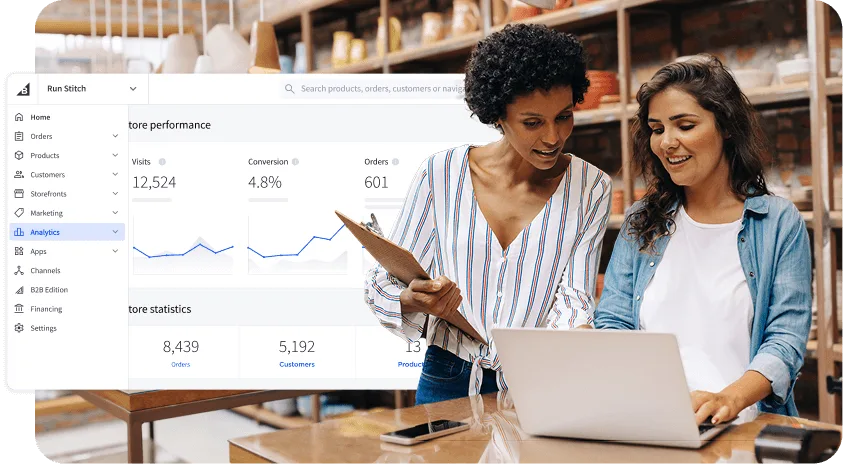
Find your favourite features.
Explore all of the capabilities of the BigCommerce platform.
Ecommerce merchandising vs. ecommerce marketing
Ecommerce merchandising is done with the goal of improving Average Order Value (AOV) by improving conversion rates on individual product pages. Ecommerce marketing, on the other hand, prioritises promoting brands and products with the intention of getting people to your store.
Going back to the brick-and-mortar example, great merchandising ensured that display was set up when you walked in the door. The person twirling a giant sale sign on the corner was the marketing that got you there in the first place.
Strategies for ecommerce merchandising excellence
Ecommerce merchandising best practises optimise product presentation through thoughtful curation, compelling visuals, and a smooth purchase experience.
What’s this effective merchandising look like in practise?
Fine tuning product management.
Curating a relevant product catalogue is foundational to ecommerce success.
There are several ways you can go about accomplishing this:
Conduct market research to thoroughly understand your target market’s needs, wants, and preferences.
Keep an eye on seasonal trends and prioritise merchandising products that do best during these times.
Consider how media consumption influences customer purchasing. Does your audience follow TikTok influencers or read trade magazines? Make sure you’re hanging out in the same places as your audience for inspiration.
Aside from curation, product management also requires thorough upkeep of product metadata. Periodically update product descriptions with new SEO keywords, swap out product images, and ensure items are properly indexed in site search.
Remember: ecommerce product page best practises are important year round.
Utilising product videos.
Videos bring items to life, demonstrating the product in action and explaining its features and benefits better than text or images alone.
There are a number of video types you can sprinkle into the mix, including:
Demos
Tutorials/explainer videos
Behind-the-scenes
Customer testimonials
Much like articles, product videos can come in many forms, and should reflect your brand. Be creative and have fun with them, and people are sure to take note.
Enhancing credibility through social proof.
You can say your product is great until your face turns blue, but this isn’t always enough. You need social proof that backs what you’re saying.
Reviews and testimonials are prime examples of social proof and its importance. In fact, ~92% of consumers view at least one review before purchasing something.
While you can’t force social proof, there are steps you can take to encourage it, and use it to drive sales:
Nudge engaged customers for reviews: Email customers a short time after purchase, asking if they’d like to leave a review. Make the review process as simple as possible, requiring as little information as possible. (You can even incentivise a review with a discount in exchange.)
Display reviews: Make sure you display all reviews, showcasing customer satisfaction and those who wanted more, as this shows authenticity and honesty.
Feature testimonials: Gather written or video testimonials from happy customers and display them prominently on your website, from your storefront to landing pages.
Showcase user-generated content: Encourage customers to share their purchases on social media and tag your business. Then, repost these mentions on your official social media channels to drive further engagement.
Proper online merchandising goes a long way, but social proof is essential to building trust.
Crafting a cohesive brand identity.
Brand identity encompasses everything from a company’s visual standards — logo, typography, colours — to brand voice and customer experience.
When you deliver a cohesive brand identity, you ultimately let customers know what to expect from your business: on-time delivery, high-quality products, 24/7 customer support, and so on.
Now, how do you go about making sure your brand identity is cohesive to begin with?
If you haven’t already, craft a brand story that details how and why your business was founded, and what your values are.
Attach a distinct visual identity to your brand that meshes well with the story.
Define your brand voice, whether it’s funny or formal or somewhere in the middle, and weave it through every element of your business, from product descriptions to social media posts.
Track engagement metrics, especially clicks and conversions, and see if your messaging and branding is delivering. If not, test out minor changes and compare. Rinse, repeat.
Optimising site-search techniques.
Site search optimisation helps customers find specific items, boosts product discoverability, and drives conversions.
Boost sales and help people find what they’re looking for by optimising search with:
Advanced search algorithms: Capable of handling spelling errors, synonyms, and natural language queries. Semantic search technology can even understand the intent behind user queries.
Autocomplete and suggestions: Assist users as they type search queries. Display relevant product names, category pages, and popular searches in real-time.
Filters and faceted search: Enable filters based on categories, price range, brands, sizes, colours, and other relevant attributes. Faceted search allows users to narrow down their search results quickly.
Personalised search results: Analyse past purchase history and browsing behaviour to offer personalised recommendations within search results.
Best of all, many ecommerce platforms offer the above functionality and more.
For example, BigCommerce has integrations with AI-powered search tools, like Klevu, making it easier to offer customers a personalised shopping experience, improved search, and truly modern ecommerce merchandising.

There's a lot to love ❤️
Watch a demo to see the BigCommerce platform in action.
Personalisation in ecommerce merchandising
Odds are, you’ve gotten a personalised piece of merchandising in your mailbox, like a coupon mailer.
Not only can you deliver that same personalised experience with ecommerce merchandising, it’s also expected: 73% of shoppers say personalisation should improve with technology.
There are a few ways you can go about powering personalisation and making it a reality.
User behaviour analysis.
User behaviour data is a treasure trove of information marketers can use to better meet consumer preferences.
Behaviour analysis data includes:
Page views
Purchase history
Emails opened
Items wishlisted
The above is only a snippet of the user behaviour data you can find. With only the data above, you can give product recommendation algorithms or tools what they need to offer a personalised shopping experience.
On top of this, you can use the above information in your email marketing platform, customer relationship management (CRM) system, and so on, opening the door to further personalised experiences.
Bonus: User behaviour data isn’t just great for personalisation, but can also help you determine optimal price points for products, whether you understand your customer segments fully, and ultimately if you’re meeting audience expectations.
Product recommendations.
Personalised product recommendations are a standard feature on ecommerce websites, especially for online stores offering a vast product catalogue aimed at different customer demographics.
By upselling and cross-selling complementary products that align with the customer’s browsing and purchase history, online retailers can increase the chances of a sale while reducing friction for the customer.
You can even carry this personalisation into suggested content for those browsing your ecommerce site, educating customers and guiding them toward a sale.
Nextbase, a manufacturer of dash cams, is a great example. By partnering with BigCommerce and offering personalised content to their customers, they were able to make contextual suggestions that led to:
122% conversion rate increase
23% increase in clickthrough rate
6.34% overall conversion rate
“Our point was, now that we have all this content, we need to deliver this content based on context. Now I know a lot about a person, and I can deliver content made for them or segmented for them.”
Retargeting.
Ecommerce stores can win back cart abandoners or website visitors who bounced by showing them retargeted, personalised ads.
Use website pixels from your ad platform of choice — Google Ads, Facebook Ads, etc. — to track user behaviour on your site.
Next, display targeted ads to would-be customers as they use search engines and browse social media networks or other websites.
Retargeting is only one of many ecommerce advertising strategies you should keep handy. Make sure you’re up to speed on the rest.
Measuring ecommerce merchandising success
The right ecommerce merchandising strategy can drive sales, traffic, and borderline world domination.
But, how can you be sure it’s working?
As is the case with all things online, there are metrics you can track to measure success.
Website traffic and conversions.
First and foremost, you need to track website traffic and conversions. Only then can you start working on conversion rate optimisation.
Your ecommerce platform should offer site tracking. If not, you can set up tracking with Google Analytics or another tool of your choosing.
From there, analyse traffic by source:
Search engines
Social media
Paid ads
Email
Referral (External blog, etc)
Next, look at your conversion rate. This tells you the percentage of site visitors who complete a desired action, whether that’s purchasing a product or signing up for a newsletter or scheduling a demo.
To further improve your conversion rate, look at your sales funnel — inspecting product page views, items added to cart, checkout, and payment, to find drop-off points.
If you notice a certain stage is costing you sales more than others, it’s time to optimise that part of the customer journey.
Customer lifetime value.
Customer lifetime value (CLV) measures the total revenue an ecommerce business can expect to generate from a single customer throughout their relationship.
You can easily calculate CLV with the following equation:
Customer lifetime value = Average order value (AOV) x Average number of customer orders
If you have historical data on select customers, you can drill down further and get a more accurate CLV with:
CLV = Order 1 + Order 2 + Order 3 + And so on
Why’s it matter?
When you know the CLV for your customers you can determine if you’re spending too much on acquisition, and if you need to adjust messaging and targeting to go up or down market.
If your typical CLV is $50 and you’re spending $100 per lead, you’ve got a problem.
Seasonal and promotional analysis.
During the 2025 holiday season alone, consumers spent a whopping $257 billion online. If you’re not running the right seasonal promotions, you’re missing out on a slice of that very large pie.
Depending on the type of business you run and your audience, you could have several seasonal surges throughout the year. The right promotional marketing campaigns during these periods can mean the difference between a smashing success and glorious flop.
Increase your chances of seasonal success by:
Examining historical sales data for noticeable fluctuations
Giving yourself at least three months to plan for seasonal promotions
Running strong discounts and promotions during seasonal surges
Revising store visuals to match seasonal promotions
Analysing past seasonal promotions to look for optimisation opportunities
Get wild on social media, share posts your customers tag you in, host giveaways, and launch a new or limited-edition product to drum up further enthusiasm during seasonal periods.
Don’t be a Grinch. Have fun with it.
Trends shaping ecommerce merchandising
Like every element of ecommerce and digital experiences, there are countless trends changing how ecommerce merchandising is expected, approached, and deployed.
Leveraging AI for enhanced personalisation.
AI can analyse loads of customer data in seconds, analysing customer behaviour in near real-time. This allows:
Hyper personalisation of product pages and content
Automatic segmenting of customers based on behaviour and preferences
Delivery of personalised ads, email marketing, and product recommendations
AI-driven personalisation will ultimately allow merchandisers to react faster, making both small and major adjustments as needed for maximum results.
Utilising user-generated content.
User-generated content can make brands more authentic, and is a crucial part of drawing in customers.
(Recall the earlier stat: 92% of people view at least one review before purchasing.)
Social media isn’t going anywhere, so it’s important to encourage customers to share product photos, unboxing videos, testimonials, and product reviews.
Drum up customer engagement by running contests, giveaways, and sharing branded hashtags on social media posts.
Advanced search tactics.
Intelligent search algorithms, including agentic AI, use natural language processing (NLP) to decode the intent behind a search query, since customers don’t always know what they’re looking for.
For example, they might type “thing to hold shower curtain rod” into the search bar when they mean “shower curtain bracket.”
To prepare for this AI-driven future of search, be sure to include:
Visual search that lets users upload images to find items
Granular search filters, like price, colour, model, and more
Agentic-ready product listings that utilise AEO and GEO practises
Whether customers are searching the old fashioned way or asking their favourite bot, the above will help you guide them to the right product and future-proof your business.
Prioritising a consistent customer experience.
Delivering a consistent customer experience in-store is one thing, but doing it online is another beast entirely.
Strive to give customers a consistent online shopping journey from beginning to end with:
An easy to navigate homepage
Clear search functionality and product recommendations
A seamless checkout experience
Post-purchase support
In the past, ecommerce merchandising was only slightly more dynamic than its in-store cousin. Now, you can offer a consistent merchandised experience from beginning to end.
Emphasis on social commerce.
Social media platforms like Instagram and Facebook have integrated shopping features that allow businesses to create online stores directly on these platforms.
Businesses can tag products in shoppable posts, enabling online shoppers to view product details and complete purchases without leaving the social media app.
Merchandisers also have numerous ways to engage with their audiences, from livestreaming to interactive polls to indirectly via social media advertising.
Capitalise on this, making every effort to have a social presence that’s as strong and complete as the one on your own ecommerce platform.
Psst. Social commerce as a whole is more important than ever. Keep up with the latest in social commerce trends here.
Adapting to omnichannel retail.
Omnichannel retail is a modern approach to ecommerce, where brands deliver a consistent experience across all channels.
With 91% of online consumers partaking in omnichannel, this experience isn’t just modern, but also expected.
Merchandising is key to a great omnichannel experience, requiring consistent branding and visuals across social ads, your online store, and anywhere else your products appear.
Fortunately, all the aforementioned tools and automation can help. Learn the latest in our 2026 omnichannel writeup.
Prioritising sustainability.
An increasing push for faster delivery times and overall use of online shopping have resulted in an equally increasing focus on the carbon footprint of ecommerce.
For good reason. Moving a shipment date even one day, allowing for a larger truckload to go out, can reduce the carbon footprint of delivery by up to 36%.
Customers are taking note: 80% of shoppers will pay more for green options.
Ecommerce businesses need to follow suit, offering eco-friendly shipping and packaging, and contributing to local causes when possible.
Then, tie it in with your ecommerce merchandising efforts. Advertise that your products are packaged in recycled material, that your organisation helped with local environmental efforts, and so on.
Advances in inventory management.
With modern inventory management systems, you can have real-time inventory levels that sync across your marketplaces and various storefronts.
In other words: There’s little excuse for selling something that’s actually out of stock.
Real-time inventory that plugs into your ecommerce platform also bolsters your merchandising efforts, letting you showcase what’s available and not out of stock.
For example, if one of your newest products is flying off the proverbial shelf and currently out of stock, you can swap out your front page merchandising efforts to showcase a proper substitution.
Thanks to programmatic and AI-powered merchandising tools, you can even automate this process. When something goes out of stock, your tool can swap it out for something else, even personalising what it shows based on someone’s purchase or browser history.
Common pitfalls in ecommerce merchandising
Despite the number of tools and modern tech that streamline ecommerce merchandising efforts, it’s not without its pitfalls. There are a number of ways you can botch merchandising itself, or ancillary efforts.
Shallow personalisation.
Customers expect personalisation. Flashy merchandising can do only so much if the customer isn’t interested in what’s shown to them. With today’s tools, you can still deliver a beautifully merchandised experience that’s also personalised.
Sloppy visuals.
Products deserve great images and videos to support them. You know your products are high quality, but low-grade images will only do them a disservice while making your brand appear unprofessional.
Include high quality photos with your products, and strive to add videos wherever they make sense.
Unhinged product suggestions.
Everyone wants to cross-sell and drive up that AOV, but there’s still an art to it.
Make sure your system isn’t suggesting completely unrelated items to customers who are in the process of shopping around. (Someone buying a camera doesn’t need a computer mouse suggested to them at every turn.)
Confusing navigation.
Imagine going into a store filled with great displays, but no way out. Make sure your site navigation, including links on product pages themselves, makes sense and is easy for shoppers to navigate, otherwise they’re bound to bounce.
The final word
Ecommerce merchandising might sound like a ton of work, but it doesn’t have to be. Especially if you’re using an ecommerce solution that empowers you with integrations, comprehensive native features, and automation for days.
There’s a lot to love about your products. Now, see why there’s a lot to love with BigCommerce, your future store and the digital shelf of your dreams.
Discover How AI is Transforming the Customer Experience
AI is quickly reshaping the landscape of ecommerce. Learn how you can prepare for the next wave of AI commerce.
FAQs about ecommerce merchandising
When tackling ecommerce merchandising in international markets, it’s important you have a strategy that takes into account: the area’s customs and language, expected customer experiences, and regional design standards.
You’ll also want to ensure your SEO strategy is adjusted for international markets, as top keywords in the U.S. may not be as important in other markets.
There are numerous tools you can use for ecommerce merchandising, including search optimisation tools, personalisation platforms, product recommendation algorithms, and analytics tools.
Modern AI can improve ecommerce merchandising by powering real-time personalisation, agentic AI ready pages, and real-time inventory tracking that ensures you don’t promote products that are out of stock.
There are several ecommerce merchandising KPIs to track, including: conversion rate, add-to-cart-rate, cart abandonment, average order value, and clicks.
While total clicks aren’t as valuable as the other KPIs mentioned, they can still let you know if your top-level messaging is getting people to destination pages or not. As always, remember to A/B test your efforts to determine which changes have the biggest impact on KPIs.
Find your favourite features.
Explore all of the capabilities of the BigCommerce platform.