


- Featured
B2B Edition
Advanced B2B features for enterprise plans.Catalyst
NewCreate stunning, high-performing storefronts that captivate and convert.Feedonomics
Omnichannel feed and data transformation.Multi-Storefront
Manage multiple unique stores from one account.International
Grow your brand across the globe.

- Launch Services
Overview
Chart your path to success with specialised services.Implementation Project Management
Experts to ensure you launch on time and under budget.Solution Architecture
Seasoned advisors to help you best design your store.Data Migration & Optimisation
Expertise on a clean and clear path to migrating your data.Enterprise Launch Package
Personal training on how to set up and launch your BigCommerce Store.

Professional Services Blog Series
Get to know our teams and how they support your success in this Q&A series.

The Global B2B Buyer Behavior Report
This in-depth report provides actionable strategies to help you sell more online.
Explore the
BigCommerce platform
Get a demo of our platform to see if we’re the right fit for your business.
Not ready for a demo? Start a free trial
Agentic Commerce Protocol (ACP): How AI Agents Will Change How We Shop

Written by
Mandy Spivey08/01/2026

Key highlights:
With the release of OpenAI and Stripe’s new Agentic Commerce Protocol, shopping is poised to shift from traditional websites to more AI-led product discovery and purchasing.
Conversational buying can now take place in ChatGPT, assisted by AI agents that continuously learn shopper preferences from real-time data and curate personalised results.
New Stripe Agentic Commerce Suite integration gives BigCommerce stores seamless access to AI-powered discovery, checkout, and payments.
A safer, more secure experience awaits shoppers and retailers who take part in agentic shopping thanks to Shared Payment Tokens (SPTs).
The global agentic AI market is set to grow by more than 40% each year, from about $5 billion in 2024 to nearly $200 billion by 2034.
The internet is evolving in bold, new ways.
One of those is through the introduction of the Agentic Commerce Protocol (ACP). Released by OpenAI and built in conjunction with payment processor Stripe, Instant Checkout is a revolutionary open source workflow that now enables shoppers, AI agents, and ecommerce businesses to complete purchases all in one place.
And newly-released Stripe’s Agentic Commerce Suite — a powerful new toolset that helps retailers succeed in this new era of AI-driven discovery by making products discoverable and purchasable by AI agents — is now available to BigCommerce stores. Through a single integration, BigCommerce businesses can connect their existing product catalogues to their choice of available AI agents, putting the newfound power of an agentic checkout experience in their hands.
“Stripe’s Agentic Commerce Suite is a major step toward making agentic commerce truly accessible for BigCommerce merchants.” — Sharon Gee, Senior VP of Product for AI, Commerce
What is the Agentic Commerce Protocol?
The Agentic Commerce Protocol (ACP) is an open standard that enables AI agents to securely and programmatically purchase goods and services from ecommerce businesses. This standardised language essentially acts as a universal "bridge" for agent-driven transactions.
ACP works by defining common rules for AI agents to curate products, manage carts, and complete checkout with online stores, allowing businesses to integrate once and sell across different AI platforms, all while keeping control over their brand and fulfilment.
This new “protocol” gives more power to ecommerce businesses and shoppers online, and with the introduction of Stripe’s Agentic Commerce Suite integration, it’s simpler than ever to plug and play into your BigCommerce store.
“BigCommerce merchants will be able to unlock AI-driven discovery and checkout flows while continuing to use their existing catalogues, order systems, and operational processes. This is exactly the kind of practical innovation merchants need to adopt agentic commerce with confidence — simplified, secure, and built to scale.” — Sharon Gee, Senior VP of Product for AI, Commerce
With the world opening up to a new era of AI commerce, let’s learn more about how the ecosystem works.
How agentic commerce works for shoppers, AI agents, retailers, and payment providers:
Shopper: Within the AI application of their choice, a shopper can discover a product or service simply by asking the chatbot. LLM then populates a selection that meets their requirements, after which the shopper selects what they wish to buy, picks a saved payment credential (or adds a new one), and grants permission to initiate a checkout through the AI agent.
AI agent: The agent interfaces with the shopper in the chat, displaying products, enabling secure checkout, and collecting payment details. When the shopper confirms the purchase, the AI agent makes a request to the business to initiate checkout on behalf of the shopper.
Retailer: The ecommerce retailer then receives a checkout request and secure payment credentials from the AI agent. The retailer can choose to accept or decline the transaction using payment and fraud signals, and is the merchant of record — the legally responsible entity that processes customer payments, handles financial transactions, and assumes liability for sales, taxes, and compliance.
Payment provider: At this point, the AI agent communicates with the business’s payment provider, relaying payment credentials via a secure payment token for the retailer to charge the buyer. The use of the token is programmatically controlled, permissioned, and logged.
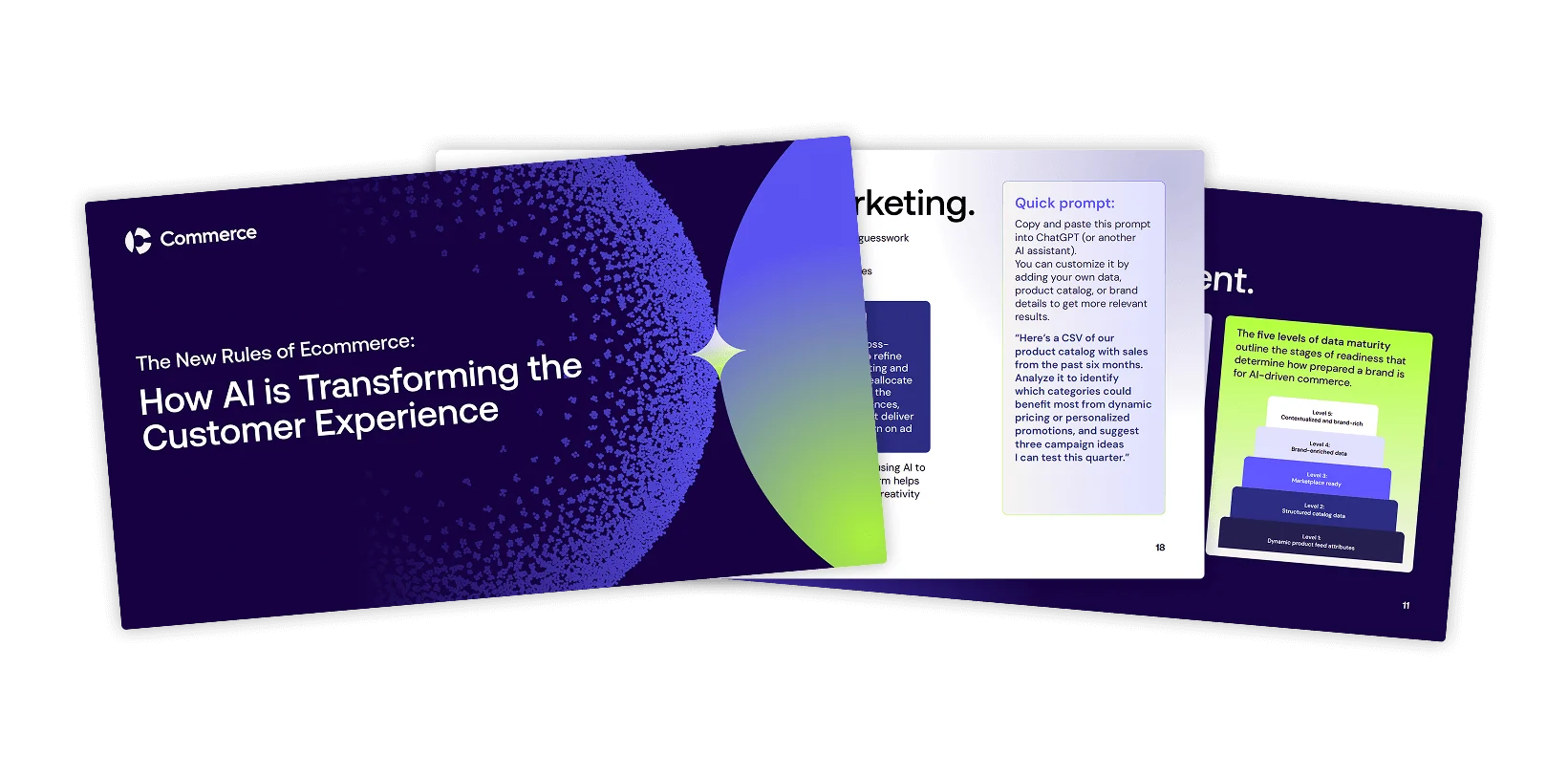
Discover How AI is Transforming the Customer Experience
AI is quickly reshaping the landscape of ecommerce. Learn how you can prepare for the next wave of AI commerce.
How does the Agentic Commerce Protocol work?
You can think about how the ACP works conceptually in three different ways: the interaction layer, the intelligence layer, and the commerce layer.
Imagine you want to find a gift for your close friend. You know they like handmade knit scarves, and that their favourite colours are blue and purple. You have a budget, which is $40 dollars.
Using the Agentic Commerce Protocol in your preferred AI platform, you could give the AI agent the following prompt:
“Can you help me find a great gift for my friend? She likes handmade knit scarves and her favourite colours are blue and purple. I can spend up to $40 dollars.”
ACP provides the standardised language for the transaction, enabling the agent to move from "finding" to "doing" the task of shopping for this set of criteria.
The interaction layer.
Upon receiving this list of criteria, the AI agent would tap into information via large language models (LLM) and display a set of results to pick from, in this case a handmade scarf from a seller who had positive reviews on Etsy. The AI agent would then initiate checkout using a webhook to generate a cart for the business on Etsy.
Once the shopper clicks “buy” a payment token is created by the AI agent, which is shared with the business, allowing payment to be processed securely and anonymously. The shopper gets confirmation that their order has been received by the Etsy store, and to keep track of their order via email.
The intelligence layer.
Distinct from the transaction itself, this layer refers to the part of the agentic commerce architecture where the AI agent reasons over a user's intent, and accesses relevant information to make decisions for them.
In order to act effectively, the agent needs access to real-time, machine-readable data. Model Context Protocol (MCP) makes this possible, and defines how AI agents securely query enterprise systems like product catalogues, inventory databases, pricing APIs, and knowledge bases to gather the necessary context.
During this discovery phase, the AI agent uses MCP to search, find, and compare products across various retail catalogues with complete, structured data.
The commerce layer.
When our shopper is ready to purchase the ideal gift for their friend, there’s a third layer that handles payment and data flow with security: the commerce layer.
After the online store gets a checkout request and secure payment credential details from the AI agent, the business can decide based on payment and fraud signals whether it will accept or decline the transaction.
The AI agent acts as a liaison again, conversing with the business’s payment provider to share payment credentials (in this case, a secure token) for the business to charge the buyer.
ACP uses existing, secure payment infrastructure, such as tokenized payments, to handle sensitive data, ensuring that raw financial details are never exposed to the AI agent.
What is Stripe’s new Agentic Commerce Suite integration?
This forward-thinking integration now enables businesses that build their stores on the BigCommerce platform to capitalise on the emerging era of AI agent-driven shopping with speed, security, and flexibility.
Key benefits include:
Agentic discovery: Products are now available to leading AI agents through a connection to Stripe — no need for time-consuming, technical individual LLM integrations.
Flexible and fast checkout: Agent-powered purchases are enabled with built-in support for taxes, shipping, and order handoff, using BigCommerce order systems and Stripe’s simple agentic checkout flow.
Maintain control: Businesses maintain merchant-of-record status, keep control over customer relationships and communications, and inform agentic shopping with inventory and pricing logic, all within the BigCommerce platform.
Fraud protection: Stores can process agentic payments using Shared Payment Tokens (SPTs) and Stripe Radar, mitigating fraud risks.
How the Agentic Commerce Suite can help your business
From boosting efficiency for online retailers to improving the customer experience, BigCommerce’s Agentic Commerce Suite integration is about to level up the way we all shop, starting with:
Operational efficiency.
For online businesses, the repetitive processes that AI agents automate significantly enhance operational efficiency.
The protocol is able to accomplish this by enabling AI agents to autonomously manage the end-to-end transaction lifecycle, from product discovery to checkout and order fulfilment.
That means businesses get assistance with:
Automation of workflows: Tasks that traditionally require humans can now be done via AI agent, reducing operational overhead and minimising human error.
Real-time decision making: AI agents tap into machine learning and predictive analytics, enabling them to make instant decisions about dynamic pricing adjustments, optimal stock allocation, and personalised offers.
Streamlined processes: Faster checkout time and lower cart abandonment rates. A single integration allows merchants to sell across multiple AI agent ecosystems.
Inventory and supply chain optimisation: Agents have the ability to manage inventory by forecasting demand and triggering replenishment automatically. They can predict disruptions, reroute shipments, and negotiate with suppliers.
Resource allocation: By automating routine aspects of the sales cycle, businesses can free up valuable human resources.
Enhanced security and compliance: The Agentic Commerce Protocol ensures that all agent-initiated transactions are verifiable, secure, and auditable, helping to mitigate fraud and maintain compliance with data protection laws.
Here’s why it matters: Businesses that implement autonomous workflows have reported operational efficiency improvements of 30 – 40%. That’s your time and money that can be allocated elsewhere.
Customer experience.
Conversational buying reduces the amount of time it takes to find a product, as the agent handles it all: from product discovery to negotiation to checkout. Predictive and personalised product results lessen the time it takes to shop, all thanks to proactive AI agents that get to know you through simple, conversational dialogue.
Transparency and security are other factors that improve the experience. Shoppers maintain more control throughout the buying process, with AI agents acting on their behalf to keep them in the loop even after a purchase is made.
Here’s why it matters: ACP and integrations like the Agentic Commerce Suite shifts commerce from search to conversation, enabling a highly efficient, AI-mediated path to purchase.
Scalability.
Protocol-based communications achieve scalability by using open standards to replace individual custom integrations with universal communication methods and support a diverse range of APIs for various commerce functions, not just payment processing.
Below are a few of the key scalability mechanisms:
Standardisation of communication: ACP provides a common language and data format for agents and merchant systems to interact, eliminating the need for a separate integration for every combination of agent and merchant.
Interoperability: Standardised interfaces allow agents to interact with multiple platforms, payment systems, and third-party tools, which greatly reduces complexity.
Leveraging existing infrastructure: Agentic Commerce Protocol is designed to integrate with existing, scalable commerce and payment infrastructures instead of building new systems from scratch.
Modular protocols: Using several specialised protocols, including transaction protocols for checkout, integration protocols for data, and payment protocols for secure authorisation, allows components to scale independently and efficiently, without a single point of failure.
Cloud-based solutions: Agentic commerce often leverages robust, scalable cloud infrastructure that can handle high traffic volumes and fluctuating demand without performance degradation.
Security and trust frameworks: Frameworks like the Mastercard Agent Pay Acceptance Framework incorporate features such as cryptographic verification, agent identity management, and real-time fraud detection. These security measures are highly scalable, enabling millions of secure transactions and fostering the confidence required for mass adoption.
Here’s why it matters: Standardisation means that instead of building thousands of specific integrations, your online business only needs to implement the protocol once, enabling you to interoperate with all other participants in the network.
Data optimisation.
In the agentic era, AI agents act as personal shoppers online, using data that businesses and shoppers provide to make millions of microdecisions in a single transaction. For your products to be visible and recommended, this data must be comprehensive and machine-readable.
Structured product feeds act as the new discovery layer, replacing traditional website browsing and keyword-based SEO as the primary way agents find products. Continuous learning through feedback loops allow AI systems to learn, adapt, and refine their actions using real-time data and interactions with shoppers, improving decision making and ensuring trust.
Agents are able to quickly compare offers, cheque product availability, evaluate customer reviews, and even negotiate based on data quality.
Accurate, structured, and optimised data enables seamless, instant checkout directly within the AI interface, eliminating the multiple points of friction that lead shoppers to abandon their cart.
Here’s why it matters: By optimising your data, you enable your business to be found by AI agents, putting your product and services in front of more people.
Discover How AI is Transforming the Customer Experience
AI is quickly reshaping the landscape of ecommerce. Learn how you can prepare for the next wave of AI commerce.
Applications of the Agentic Commerce Protocol
Autonomous product sourcing and pricing.
Product sourcing and product pricing in an agentic commerce environment fundamentally shifts from a human browsing websites to AI agents querying merchant systems for information.
The workflow essentially follows these steps:
AI agent queries: A user prompts an AI agent with a request.
Data retrieval: The AI agent uses protocols like the Model Context Protocol (MCP) to query the product catalogues and inventory systems of various merchants who have exposed their data in a structured, ACP-compliant format.
Product data optimisation: Businesses must provide rich, detailed product attributes (material, dimensions, compatibility, colour, specific features) in their data feeds. The richer the data, the more likely the AI agent is to select and recommend the merchant's product based on the user's specific criteria.
Comparison and recommendation: The agent analyses the retrieved data, compares options across different businesses, and presents the best curated choices to the user.
Checkout initiation: Once the shopper selects a product, the AI agent uses ACP-defined endpoints to initiate the purchase, manage the cart, and handle payment processing.
Conversational agents completing transactions.
With shopping moving away from manual search toward conversational AI-enabled personal shopping assistants, business and shoppers benefit in several different ways.
Shoppers who share their product criteria in their favourite AI platform get to experience less friction — fewer tabs to navigate, reduced cognitive load, better security — which all adds up to a more seamless experience in the long run.
Businesses that make products discoverable and sourceable by AI agents put their products and services in front of new target audiences, expanding their reach while increasing overall scalability using their existing systems.
Inventory balancing between platforms.
The Agentic Commerce Protocol is also able to facilitate the communication that enables merchants to utilise dynamic inventory management systems, allowing AI agents to interact with merchant systems in a machine-readable way.
Its core function is to convey information securely and in a standardised format, including:
Real-time stock availability: Businesses can publish their near real-time inventory levels to any ACP-compatible AI agent or platform.
Product and price discovery: Agents can query different platforms to compare options and find the best availability for shoppers.
Transaction execution: ACP handles the secure and authorised transaction process, allowing the AI agent to place an order and ensuring the order is logged in the business's system.
AI agents working on behalf of the business can also forecast demand, trigger replenishment orders, and recommend stock allocation adjustments across channels, preventing overselling on the backend.
Intelligent affiliate and partner ecosystems.
The rise of agentic AI in commerce will not only alter the way we shop, but how we promote products, as well. As we move toward more AI-led shopping and product discovery, traditional affiliate marketing may begin to shift in a few ways:
Shift in discovery: AI agents act as personal shoppers, aggregating product information from various sources and making the best recommendations based on personalised preferences, bypassing comparison websites and affiliate links.
Performance-based models: Affiliate and partner programmes may need to adapt to performance-based models that reward being part of the AI's data pool or successful transactions initiated by the agent, rather than old-school metrics like website traffic or clicks.
Data sharing and integration: Businesses must integrate their product catalogues and systems to be accessible to AI agents using protocols like ACP, ensuring their products are discoverable in new AI-driven sales channels.
Trust and standards: The protocols themselves create a necessary layer of trust that ensures accountability in agent-led transactions, which is crucial for businesses and affiliates.
The final word
The Agentic Commerce Protocol allows businesses to put their products in front of an entirely new segment of shoppers online, with AI agent liaisons streamlining the many steps it takes to make it happen.
While the world of ecommerce is expanding every day, there are new opportunities to simplify it — from implementing agentic checkout to enabling AI-assisted shopping in your store. Integrations like Agentic Commerce Suite make it easy.
In this brave new phase of AI ecommerce, you don’t have to do it alone.
Set your business up for success by staying on the forefront of technology with an ecommerce platform built to support agentic commerce, today and into the future.
FAQs about Agentic Commerce Protocol
What does the Agentic Commerce Protocol mean for online shopping?
For shoppers, the Agentic Commerce Protocol allows ChatGPT users to find and buy anything — safely, securely, and anonymously — with trusted and quick recommendations. Ecommerce retailers are now empowered to reach buyers in real time, accept safe and secure payments via a new channel, all while maintaining control over which products are sold, how they are shown, how transactions are processed, and how orders are fulfilled on their end.
What is Google’s Agent Payments Protocol (AP2) and how does it relate to ACP?
Google's Agent Payments Protocol (AP2) is a framework for AI agents to securely make purchases using cryptographic authorisations, building trust and accountability in agentic commerce, while the Agentic Commerce Protocol (ACP) by Stripe and OpenAI focuses on the broader checkout and ecommerce integration, with AP2 handling the secure payment authorisation layer (using signed mandates for verification) within the larger agent-driven transaction ecosystem defined by ACP.
AP2 ensures cryptographic proof of user consent, complementing ACP's flow for integrating AI agents into merchant checkouts, making them distinct but complementary standards for autonomous commerce.
Does the Agentic Commerce Protocol replace existing ecommerce platforms?
No, the Agentic Commerce Protocol doesn't directly replace existing ecommerce platforms, but rather integrates with and transforms them, creating a new layer for AI agents to facilitate shopping. ACP does this by standardising how agents communicate with a retailer’s systems for automated product discovery, negotiation, and purchase, making platforms more "agent-ready".
Is the Agentic Commerce Protocol open source?
Yes, the Agentic Commerce Protocol is an open-source standard, developed together by OpenAI and Stripe, released under the Apache 2.0 licence to enable AI agents and businesses to conduct transactions securely and transparently, while allowing retailers to maintain control over their sales process.
What is agentic commerce and its workflow?
Agentic commerce is a revolutionary business model that engages online users and businesses, involving AI agents carrying out activities on their behalf. Think of the agent as the personal shopper, taking care of product search, authenticity confirmation, price comparison, and payment processing.
How a typical agentic commerce workflow functions:
1. User intent capture: The agent works to understand what a shopper wants.
2. Evaluation and decision: The agent compares product features, costs, and delivery times.
3. Transaction execution: The agent approves the purchase and processes the payment through secure tokens.
4. Post-purchase actions: The agent monitors the delivery, handles the returns (if there are any), and updates the shopper's preferences to learn over time.
This workflow never stops working. Agentic commerce is continuous and without human delays, making digital commerce faster, more reliable, and data-driven, turning business logic into automated decision-making.
What are some benefits of the Agentic Commerce Suite integration?
For shoppers, product curation is made more frictionless, safer, and faster. For ecommerce businesses that build their stores on BigCommerce, a new world of agentic opportunity has opened up, allowing them to connect their existing product catalogues to AI agents to power an agentic checkout experience, all while scaling their business and still maintaining control of their brand.
The entire process is made safer thanks to Shared Payment Tokens that allow shoppers to protect their payment credentials while enabling retailers to mitigate fraud risk from non-human traffic.
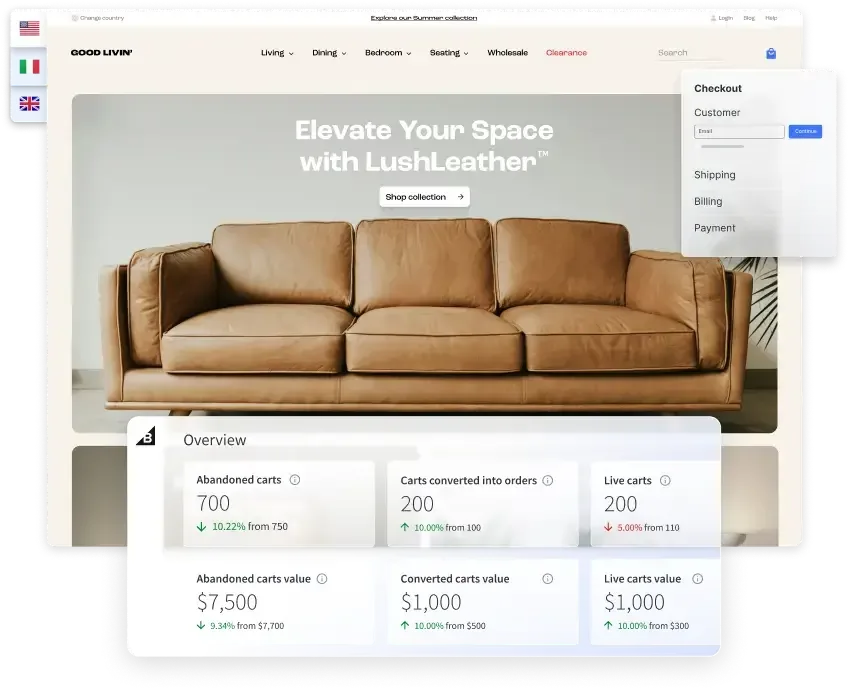
⏰ Isn't about time that you evaluated your ecommerce platform?
Request a demo to see how the BigCommerce platform is different.