- Start & Build

Product Overview
What you can do with BigCommerce.
Agentic Commerce
 AI-powered solutions for growth.
Design Your Store
Build your store with or without code.
Apps & Integrations
Over 1,200 apps to help you grow.
Migrate to BigCommerce
Switch from Shopify, Woocommerce, Salesforce, Magento, and more.
- Launch Services
Overview
Chart your path to success with specialised services.Implementation Project Management
Experts to ensure you launch on time and under budget.Solution Architecture
Seasoned advisors to help you best design your store.Data Migration & Optimisation
Expertise on a clean and clear path to migrating your data.Enterprise Launch Package
Personal training on how to set up and launch your BigCommerce Store.

Professional Services Blog Series
Get to know our teams and how they support your success in this Q&A series.


Create your new website.
See if the BigCommerce platform is a good fit for your business.
No credit card required.

Written by
Anita J. Temple11/06/2026

The Human Side of Commerce's AI Future
Get The Print Version
Tired of scrolling? Download a PDF version for easier offline reading and sharing with coworkers.
A link to download the PDF will arrive in your inbox shortly.
Key highlights:
AI reshapes org structures, not just jobs. Research shows organizations embracing AI see a 15% decline in middle management, nearly 50% growth in cross-functional roles, and a 400%+ wage premium for high-agency engineers.
Data gets you discovered — story gets you chosen. AI agents surface products based on catalog readiness, but humans set the purchase parameters and brand storytelling drives those preferences.
Magical thinking is a real risk. Deploying AI on top of broken processes accelerates dysfunction, not fixes it. Successful adoption requires clean data, limited scope, and motivated employees — not just new tools.
Human judgment is the new bottleneck. As AI takes over execution, the scarce resource shifts to deciding what to execute. Forrester's Joe Cicman: machines getting smarter makes human expertise more valuable, not less.
Friction isn't always the enemy. Laser Clinics Group learned that removing steps can produce faster flows and worse outcomes. Knowing which friction to keep requires human context no algorithm can supply.
What Commerce Live 2026 taught us about people, not just platforms
Commerce Live 2026 was, by any measure, a conference with a laser focus on artificial intelligence. The keynotes covered agentic commerce. The product sessions showcased AI-powered catalog enrichment, conversational search, and autonomous purchase order processing. If anyone still wanted confirmation that AI has moved from buzzword to business infrastructure, the two-and-a-half-day event provided solid evidence.
But something else kept happening. In session after session, conversations that started with technology kept circling back to people. The professor who shared research showing that AI is flattening organizational structures faster than most companies realize. The futurist who argued that getting discovered by an AI agent and getting chosen by a human are two completely different problems. The Forrester analyst who called AI a "goal-seeking bullet train," suggesting that human judgment about where to aim it is the only thing that matters. The Commerce executive who pulled out his phone on stage to show an AI-powered checkout experience that added clicks, got the order wrong, and made everything worse.
This final blog of the Commerce Live 2026 series is about that side of commerce — the half that recognizes that at its core, commerce is a uniquely human experience.
"I believe the promise of artificial intelligence is that it's helping us humans take the robot out of the human — so we can do less of the menial and the mundane and more of the meaningful and the humane."
— Anders Sörman-Nilsson, futurist and author
What the research actually shows
Dr. Arthur O'Connor, Distinguished Lecturer and Academic Director at the School of Professional Studies at City University of New York, opened his keynote, The AI Revolution Is Underway: How Generative AI Is Changing Jobs and Organizational Structures, with a disclaimer: most of what we think we know about AI's impact on organizations is either anecdote, vendor announcement, or lab simulation. The reality on the ground is more significant than the headlines suggest.
O'Connor had gone looking for structural change — not adoption rate polls, but evidence of actual organizational transformation. What he found surprised even him. "Every single test I ran came out statistically significant," he explained. "That means there's a 99.9% probability it is causal rather than due to random effects."
The numbers: organizations that have embraced AI are showing a 15% decline in middle management layers. Cross-functional job structures are increasing by nearly 50%. The premium for high-agency software engineers has grown over 400% relative to other workers. His analysis: AI isn't replacing people — it's changing the shape of organizations, making them flatter and more cross-functional, while concentrating value at the top and creating new expectations for everyone in between.
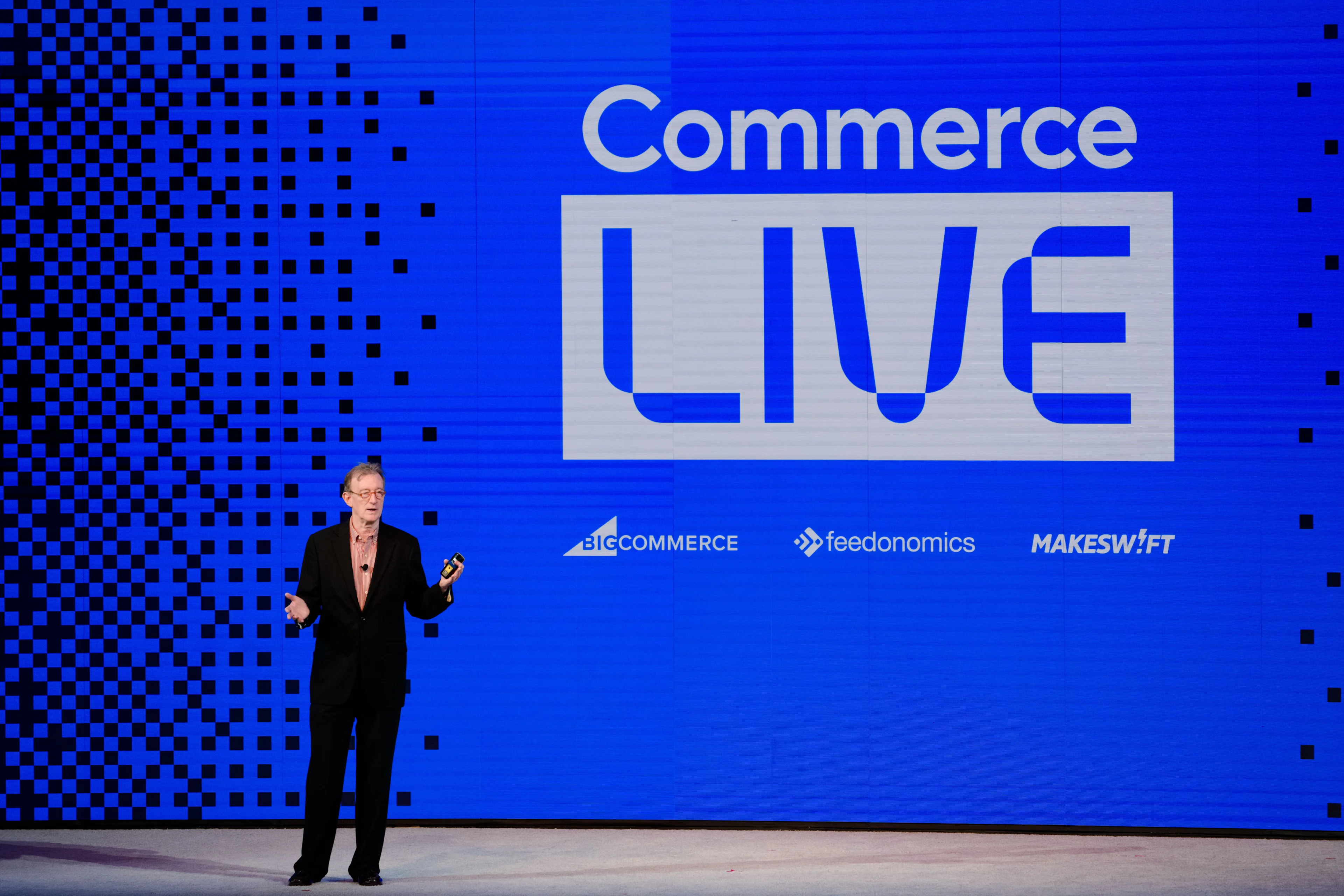
He identified two failure categories that recur when organizations try to scale AI, neither of which is a technology problem. The first traces back to how pilots are run. Successful pilots share four characteristics: clean data, limited scope, a well-defined development environment, and informed, motivated employees. When those conditions don't hold in broader rollouts, results collapse. He cited a study in which nearly 30% of employees admitted to actively undermining AI initiatives. Their reasoning made perfect sense — they realized that they were being trained to replace themselves.
The second failure category he called "magical thinking": the belief that deploying AI on top of broken processes will fix them. "AI does not fix poor management practices," O'Connor stressed. "In fact, it can accelerate them and make the problem worse."
His four-part prescription: provide incentives for people to adopt AI rather than threatening them with replacement; recruit for high-agency employees who can operate with AI amplification; rethink HR as a talent management function rather than a compliance function; and build governance as the foundational layer that makes it possible to trust what AI produces at scale.
"Organizations will have to redefine what human resources look like. Broader context, multi-disciplinary roles, smaller teams — to reduce that communication and context overhead." — Dr. Arthur O'Connor, City University of New York
The proficiency gap is the real blocker
As a panelist for the session, The Data Readiness Sprint: What B2B and B2C Leaders Must Do Right Now, Ilia Antipin, Head of Technology Consulting at EPAM Digital, shared that he consistently finds three gaps when assessing a client's AI readiness: data quality, workforce enablement, and the absence of an overarching strategy. In his view, the third is the hardest to resolve and the most underestimated.
"The definitions of these things are still being determined," he explained. "They're being determined by the street and by the buyers in the market." Commerce leaders are being pulled in every direction at once: go full transformation now, don't try to fix everything at once, build your own stack, don't build anything, etc. The volume of conflicting advice creates a paralysis that no additional information resolves.
His solution was direct: stop reading and start building. "While you're waiting for your flight, open a laptop and build a Claude skill." Not because every experiment will succeed, but because hands-on experience surfaces real gaps faster than any audit, and personal experimentation by leaders signals to the rest of the organization that adoption is expected, not optional.
"You can't just deploy new AI capabilities and expect your employees to succeed with them. It's not yet another screen, not yet another tool. It's a different way of interaction between a human and a machine — and it requires a lot of onboarding, enablement, and education."
— Ilia Antipin, Head of Technology Consulting, EPAM Digital
Data gets you discovered. Story gets you chosen.
In his keynote, When AI Becomes the Buyer: What Really Changes in Commerce (and What Doesn’t), Futurist and author Anders Sörman-Nilsson posed a question relevant to everyone in the room: in a world where AI agents are increasingly deciding what gets recommended, found, and purchased, what is the role of brand?
His answer came in two parts. First: data gets you discovered. If your product catalog isn't structured, enriched, and readable by AI agents, you don't exist in their world. An AI agent shopping on a customer's behalf will surface your competitor's products — not because the customer prefers them, but because their data was ready and yours wasn't.
But the second part is what Sörman-Nilsson pushed attendees to act on: story gets you chosen. Even in a world where AI handles discovery, humans still set the parameters. A customer delegating a purchase to an agent doesn't hand over a blank check. They specify preferences, values, and constraints — sustainable sourcing, premium quality, local manufacturing, authenticity. Those parameters come from brand relationships built over time through human storytelling, not from catalog attributes.
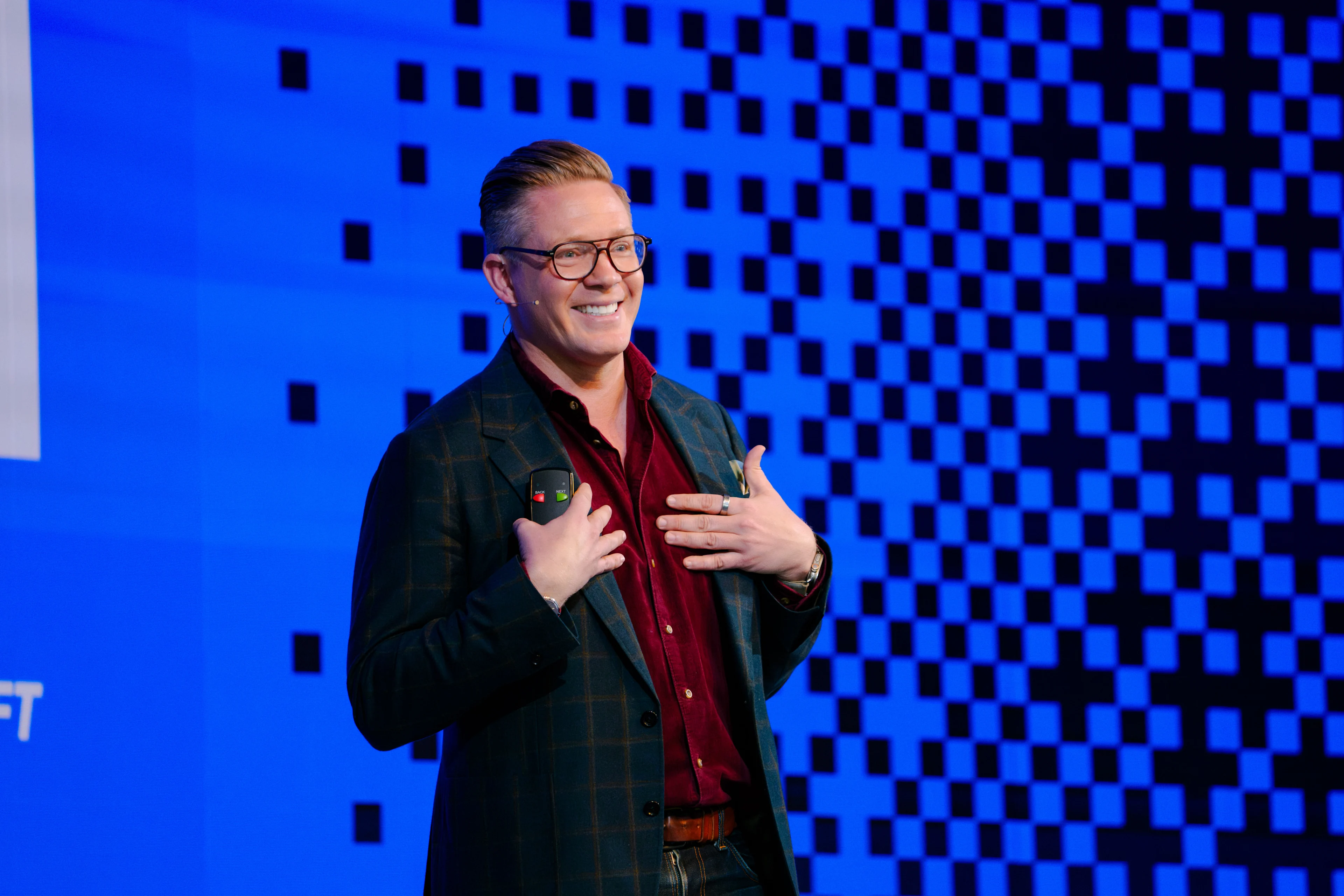
He made the economic case by way of the Significant Objects project: anthropologists bought random trinkets for roughly a dollar each, commissioned writers to attach human stories to them, then resold them on eBay. The average markup was 3700%. The objects hadn't changed. The story had.
"Your brand stories will still be the parameters that humans feed into the AI agents to make selections for them."
— Anders Sörman-Nilsson, futurist and author
His practical framework: score yourself honestly on finding (structured data, enriched attributes, schema compliance) and feeling (brand voice, emotional resonance, storytelling that creates desire before a purchase decision is ever made). He cautioned, most brands are investing heavily in one column at the expense of the other.
The buying journey has never been more human or more complicated
Three speakers on the Beyond the Funnel: Designing Commerce for how Buyers Actually Buy, panel made this concrete. Zoe Devine, Head of Digital CX at Laser Clinics Group, described a digital transformation that forced her team to confront a fundamental tension: the impulse to remove friction and the necessity of preserving it.
She explained that while the consulting firm advised them to reduce the booking flow, her team pushed back. The questions flagged for removal included: What's your skin tone? How does your skin respond to the sun? Neither were conversion obstacles, they were clinical requirements. Removing them would have delivered a faster booking flow, but worse outcomes for clients. The insight only became visible because humans who understood the clinical context were embedded in the design process, not just the analytics.
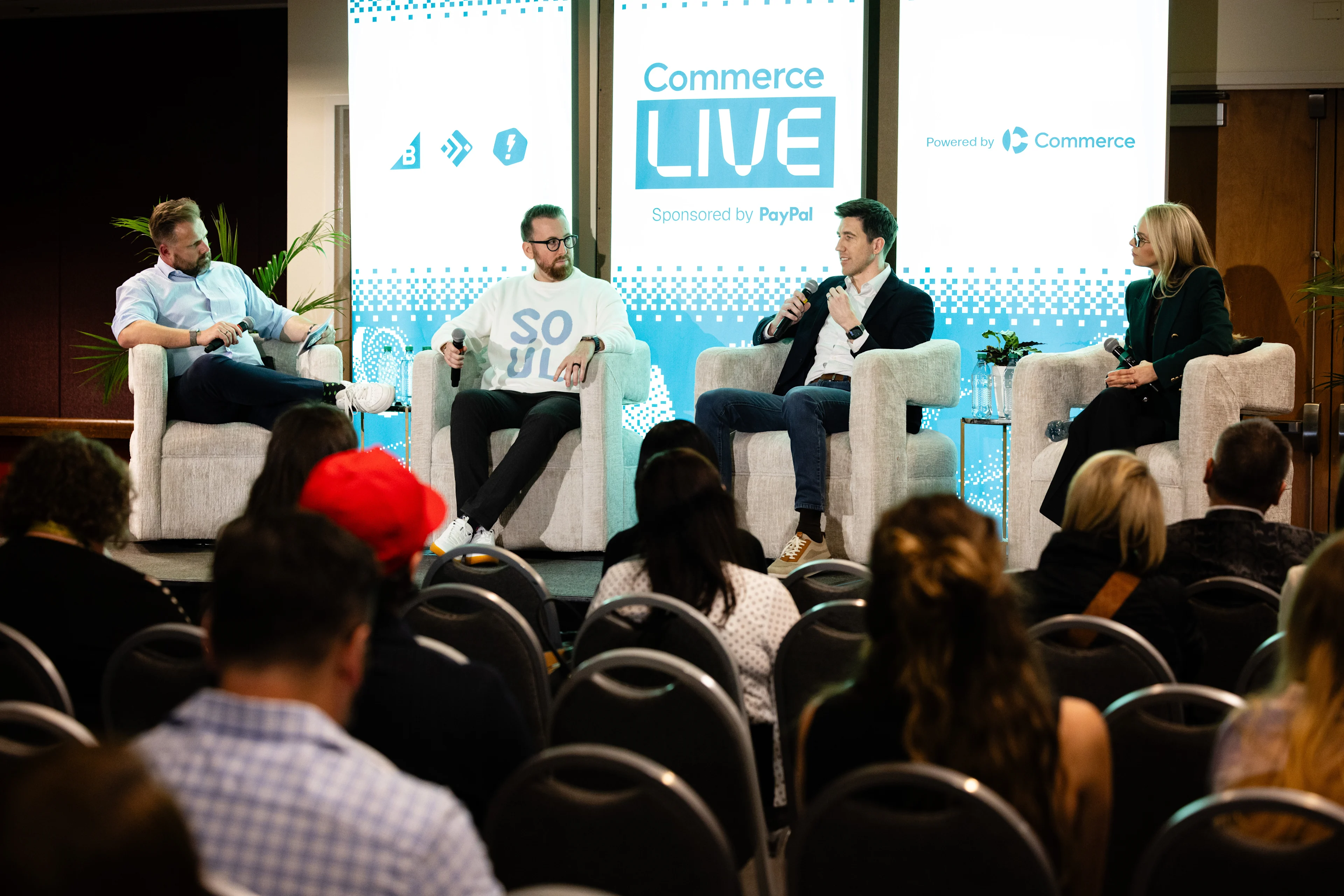
Chris Baltusnik, Director of Digital Experience and E-Commerce at Vitamix, offered a complementary perspective. When Vitamix launched on TikTok Shop, the internal debate was whether high-ticket blenders would sell on a platform associated with impulse purchasing. His view: the question itself was wrong. TikTok's value wasn't in direct conversion, but in establishing consideration and awareness that could drive pull-through to Amazon and DTC. He pointed out that getting that call right required human judgment about channel intent that a purely metric-driven approach would have gotten backwards.
Further validation was provided by Jared Shaner, VP of Strategic Accounts at Zaelab. He explained that as B2B brands build direct-to-consumer channels, there's a temptation to design them purely as transaction engines. That's a mistake.
"DTC destinations become destinations for people to learn, to become part of the brand, to have a little bit of soul in what they're doing — whether we're selling skincare or industrial hardware products."
— Jared Shaner, VP of Strategic Accounts, Zaelab
The common thread: AI can compress the buying journey, remove steps, predict intent, and personalize at scale. What it cannot do is manufacture the desire to engage with a brand in the first place. That still originates in human storytelling and the kind of relationships that take time and intentionality to build.
Human judgment is becoming more valuable, not less
In the session, The Systems-Thinking Mandate: Redefining B2B Commerce in an AI-Native World, Joe Cicman, Principal Analyst at Forrester, made the point that cut against prevailing anxiety in the room: "Because machines are becoming more intelligent, that makes human expertise and judgment all the more valuable. The bottleneck now shifts from execution to deciding what to do — what execution to do."
His metaphor for AI deployment was precise: a goal-seeking bullet train. Point it in the right direction and it will get there in an instant. Point it in roughly the right direction and it will still get there, just possibly somewhere you didn't intend. The human judgment about what outcome to target, what causation looks like in a specific business, what the CFO will actually validate as ROI — that is irreplaceable. No agent supplies it.
Ali Afralirad, Chief Revenue Officer at Commerce, offered the most candid illustration during The Future of Customer Experience session. On stage, he held up his phone to walk the audience through a recent experience with Starbucks' AI-powered ordering integration. He'd been curious, he said. What he found was that the interface added steps and his order came out wrong. Basically, the experience was worse than using the app without AI.
The story landed because it was honest: deploying AI without a clear friction point to solve produces noise, not signal. And the judgment about when and where to deploy — when a capability isn't ready yet — is human work that cannot be automated away.
The final word: Humans required
Commerce Live 2026 made the case for AI in commerce as thoroughly as any event in recent memory. The product announcements were real, the customer results were measurable, and the trajectory toward a world where agents play a significant role in discovery and transaction is no longer speculative.
There’s no denying, what’s happening is both exciting and scary. It was reassuring to find that so many commerce leaders and industry experts agree that humans must be kept in the loop. The research, examples and insights they shared made three things crystal clear:
Organizational structures being built around AI still need humans to design them, govern them, and make the judgment calls agents cannot.
The buying journeys being reshaped by AI compression still need brand stories that create desire before a purchase decision is made.
The tools deployed inside commerce operations still need merchants who know the difference between a process worth automating and one worth redesigning from scratch.
Sörman-Nilsson's formula for what that takes: emotional intelligence, unique intelligence, creative intelligence (all distinctly human capacities) augmented by digital tools that amplify reach and remove the robot from the human so we can focus on meaningful work.
The question he left Commerce Live with is the right one to end on: are you building desire in humans while becoming legible to machines — or only doing one?
In commerce today (and moving forward), brands need to do both. The ones that figure out how to deliver these equally, consistently, and at scale, are the ones that will still be standing when the dust settles.
To learn more about how Commerce is helping brands thrive in an AI-driven world, visit https://www.commerce.com/momentum/.

⏰ Isn't about time that you evaluated your ecommerce platform?
Request a demo to see how the BigCommerce platform is different.