


- Launch Services
Overview
Chart your path to success with specialised services.Implementation Project Management
Experts to ensure you launch on time and under budget.Solution Architecture
Seasoned advisors to help you best design your store.Data Migration & Optimisation
Expertise on a clean and clear path to migrating your data.Enterprise Launch Package
Personal training on how to set up and launch your BigCommerce Store.

Professional Services Blog Series
Get to know our teams and how they support your success in this Q&A series.

The Global B2B Buyer Behavior Report
This in-depth report provides actionable strategies to help you sell more online.
Keeping Commerce Weird Podcast: New Tech Can’t Rewrite Human Nature
Create your store and start selling today.
Create your new website.
See if the BigCommerce platform is a good fit for your business.
No credit card required.

Written by
Annie Laukaitis22/09/2026
Keeping Commerce Weird Podcast: New Tech Can’t Rewrite Human Nature
Get The Print Version
Tired of scrolling? Download a PDF version for easier offline reading and sharing with coworkers.
A link to download the PDF will arrive in your inbox shortly.
Key highlights:
Commerce technology keeps evolving, but the fundamental things shoppers want remain remarkably consistent.
The biggest commerce innovations succeed by removing friction from how people find, buy, and receive what they want.
AI can simplify product discovery, but without enough context, it can create new friction and lead shoppers in the wrong direction.
Automation makes sense for routine purchases, but discovery, comparison, and the thrill of finding something new remain valuable parts of shopping.
As AI influences more purchase decisions, brand reputation, reviews, and other signals of trust could play a bigger role in which products get recommended.
Commerce changes. Human behavior doesn’t.
Every era of commerce comes with a new technology promising to change how people buy. But underneath the new channels, interfaces, and buzzwords, shoppers are still trying to solve many of the same problems they always have.
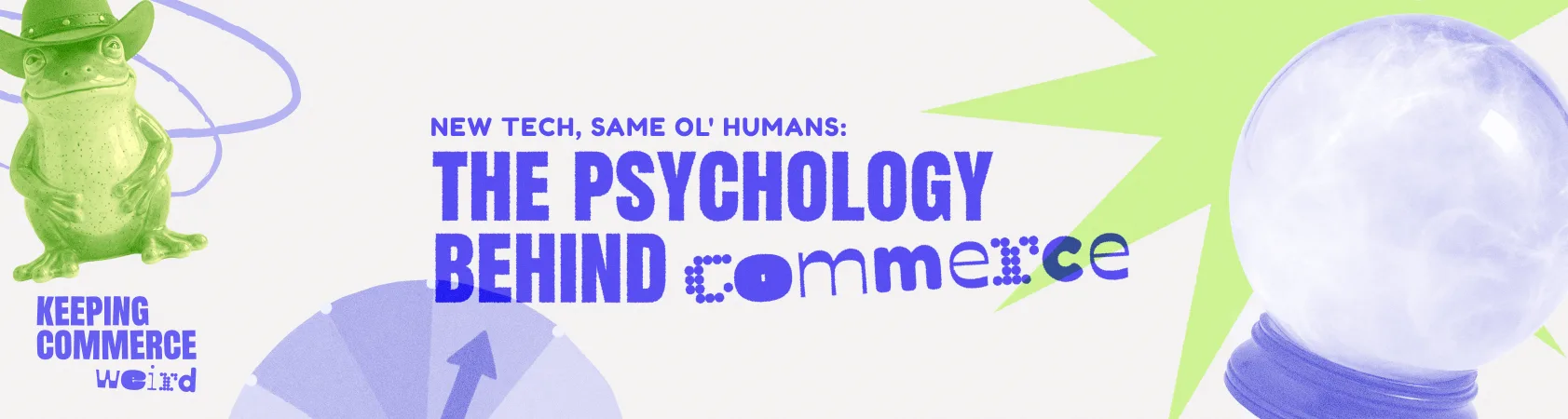
That’s the focus of this episode of Keeping Commerce Weird. In “New Tech, Same Ol’ Humans: The Psychology Behind Commerce,” Travis Hess sits down with returning guest Al Williams, Vice President of Market Strategy at Commerce, to look beyond the latest trends and explore the patterns that have shaped commerce for generations.
Their conversation comes back to one idea: The technology keeps changing, but human behavior doesn’t change nearly as quickly. From mail-order catalogs to ecommerce to AI agents, the biggest shifts in commerce have consistently been driven by the same goal: removing friction between people and what they want.
Here are the key insights from the discussion.
Keeping Commerce Weird Podcast recap: New Tech, Same Ol’ Humans: The Psychology Behind Commerce
The history of commerce is really the history of removing friction.
Travis Hess: You went back through the entire history of ecommerce looking for patterns. Not technologies, but patterns. At the highest level, what did you find?
Al Williams: “I started this thinking, ‘What trends are happening today? Where are we going with commerce? Where is the ball going to move?’ When people talk about trends, they talk about agentic commerce, orchestration, connectivity, choice, and convenience.
What I started to do was go back into history and say, ‘History always repeats itself. What are the patterns that we see there?’ From some of the first transactions that ever happened, regardless of whether they were on an ecommerce platform or not, I think people generally just want a few things.
They want to find what they want as quickly and frictionlessly as possible. They want to check out easily and conveniently. And now, in the age of ecommerce, they want to know when they’re going to get it. We also want to be recognised for loyalty.
Regardless of whatever technology exists, the technology is really supporting the friction that results from the desires and wants of a human.
If brick-and-mortar were the only option, the friction would be location and the fact that you had to be physically located near a store. The introduction of mail-order catalogs and fulfilment centers became a technology that addressed that friction: ‘I just want to buy something, and I want it accessible and close to me.’
Ultimately, the patterns I’ve seen are less about the technology and more about the introduction of a new channel or the exposure of a new friction point. Then technology has to rise to solve that level of friction for us.”
Key takeaway
The technology behind commerce keeps changing, but the problems it solves are remarkably consistent. From mail-order catalogs to ecommerce, meaningful innovation has largely followed the same pattern: identify what makes finding, buying, or receiving something harder than it needs to be, then remove that friction.
AI can remove friction, but it can create it too.
Hess: Is AI removing friction by embedding context into these conversations, which makes it easier to find something?
Williams: “Absolutely. Rather than going to five, six, or seven different places to evaluate something that I want, I can have it all in one place. So if the friction point becomes, ‘I want to find something easily,’ then that absolutely removes the friction.
But it can potentially introduce more friction, too. If we move into agentic checkout within an LLM or an agent surface, we remove that secondary friction, which is, ‘Let me buy it as easily as possible.’
I was thinking about agentic discovery and being let down in some of those cases. I used to work at The Container Store, and people would come in all the time and say, ‘I’m looking for a box.’ And I’d say, ‘Okay, where’s the box going? Are you mailing it? Is there liquid going in it? What size do you need?’
Some people would come in, and I would point them to a 14-by-14 corrugated box. No problem. Other people were looking for a one-by-one-inch acrylic box that was fuchsia. But every person walked in and said, ‘I’m looking for a box.’
I feel like that is AI right now. That is ChatGPT, Perplexity, and Gemini. Somebody comes in and says, ‘I’m looking for XYZ.’ If you don’t have the context to ask the right questions, or even know what context you need to enter, you’re going to be disappointed.
It’s our job as experts in the field to educate businesses on how to use the tools in a way that alleviates the friction they could otherwise introduce themselves.”
Key takeaway
AI can collapse a fragmented discovery process into a single interaction, but convenience without context can still lead shoppers in the wrong direction. The opportunity for brands is to make sure AI has the information it needs to understand intent, ask better questions, and help customers reach the right decision with less friction.
Convenience won’t eliminate the experience of shopping.
Hess: Do you agree that a large portion of the population actually enjoys shopping? I don’t want a bot to take that away from me in many categories. In some categories, I don’t care. I order the same toothpaste all the time. Do I really care if someone can find it cheaper somewhere, as long as it gets to me before I run out?
Williams: “I think there’s a difference when it comes to commodities. That’s why I think Amazon has been so successful. When you need something like toilet paper or sponges, the convenience of a marketplace is really valuable.
But for me, I actually like the treasure hunt. I have the time and convenience to go to three, four, five, or six stores, or look at multiple websites. If I want to buy a bathing suit, I can research online, go to a few stores, and find the one I want.
At the same time, if you walk into TJ Maxx, you still want to look up and know where the men’s, women’s, sporting goods, or accessories sections are. That in and of itself removes a level of friction. It says, ‘Where do I need to go in the store to find the thing that I want?’
From that perspective, agentic commerce removing friction for commodities is absolutely going to be a large trend and fully adopted. But there is always going to be a level of personal validation for a large subset of people who love the hunt. They love to shop. They love to find the deal.”
Key takeaway
Convenience matters most when the purchase itself is routine. But for discovery-driven categories, browsing, comparison, and validation are part of the experience consumers value. As automation expands, brands need to understand the difference between friction that gets in the way and friction that makes shopping feel rewarding.
Trust becomes more valuable when AI influences the decision.
Hess: Where I struggle with agentic discovery is trust. To the extent those recommendations don’t map back to what you were expecting, people are going to get frustrated. Or even worse, if you buy something that was recommended and it turns out not to be what you expected, that creates a problem for both the shopper and the brand.
Williams: “There are going to be enough cases where somebody blindly takes a recommendation at face value and is disappointed in what they get. I think what will happen quickly is that brands will either pay for, or there will be, a ranking system where you’re penalised or valued based on brand recognition, number of returns, positive reviews, or whatever that looks like.
There’s going to need to be some verification pattern that arises. That’s my crystal ball prediction. If LLMs are actually going to hold the lens of visibility or access to consumers, and the influence itself, of course it’s going to be worth it.”
Key takeaway
As AI plays a larger role in product discovery, trust could become an increasingly important signal of visibility. Brand recognition, positive reviews, return rates, and other markers of credibility may help AI systems determine which products to recommend, making reputation more important as consumers rely on those recommendations.
The final word
Commerce has never stopped evolving. New channels emerge, new technologies reshape expectations, and AI is creating yet another way for people to discover and buy. But as this conversation makes clear, the motivations behind those decisions haven’t changed nearly as much.
People still want to find what they need, buy it easily, know when they’ll get it, and feel confident they made the right choice. The technologies that endure are the ones that make those experiences easier without losing what people actually value about shopping.
As AI takes on a larger role in commerce, that distinction will matter. The opportunity isn’t to remove every bit of friction from the journey. It’s to understand which friction gets in the customer’s way and which parts of the experience are worth preserving.
For the full conversation on friction, AI, consumer psychology, and what the history of commerce can teach us about what comes next, listen to “New Tech, Same Ol’ Humans: The Psychology Behind Commerce” on Spotify.

Keeping Commerce Weird
A business podcast, but make it weird. New episodes out now.