- Start & Build

Product Overview
What you can do with BigCommerce.
Agentic Commerce
 AI-powered solutions for growth.
Design Your Store
Build your store with or without code.
Apps & Integrations
Over 1,200 apps to help you grow.
Migrate to BigCommerce
Switch from Shopify, Woocommerce, Salesforce, Magento, and more.
- Launch Services
Overview
Chart your path to success with specialised services.Implementation Project Management
Experts to ensure you launch on time and under budget.Solution Architecture
Seasoned advisors to help you best design your store.Data Migration & Optimisation
Expertise on a clean and clear path to migrating your data.Enterprise Launch Package
Personal training on how to set up and launch your BigCommerce Store.

Professional Services Blog Series
Get to know our teams and how they support your success in this Q&A series.

The Global B2B Buyer Behavior Report
This in-depth report provides actionable strategies to help you sell more online.
Keeping Commerce Weird Podcast: What Agentic Commerce Means for Brands
Create your store and start selling today.
Create your new website.
See if the BigCommerce platform is a good fit for your business.
No credit card required.

Written by
Annie Laukaitis20/04/2026
Key highlights:
AI is shifting from assisting buyers to becoming the buyer, fundamentally changing how commerce works.
Adoption is accelerating because AI is immediately useful, not because teams are more technical.
The most successful brands balance digital efficiency with human storytelling to serve both machines and people.
AI agents are emerging as a new customer layer, making purchasing decisions on behalf of users.
Brands that fail to optimise their data, systems, and experiences for AI risk becoming invisible.
Ecommerce has spent years optimising how people shop. But what happens when the buyer is no longer the one doing the shopping?
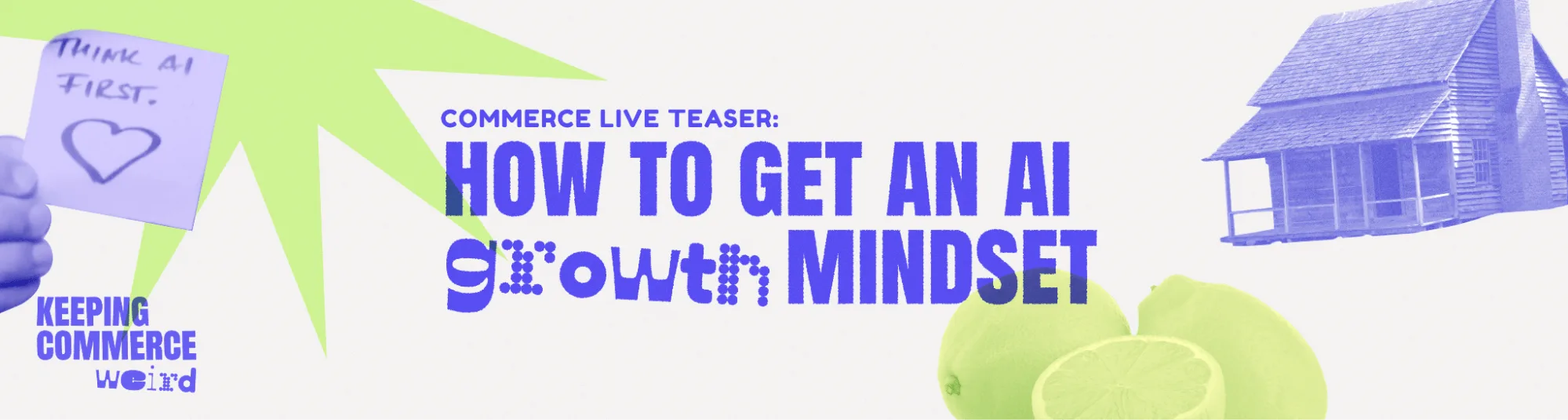
That’s the focus of this episode of Keeping Commerce Weird. In “How to Get an AI Growth Mindset,” Travis Hess, CEO of Commerce, sits down with futurist Anders Sörman-Nilsen, founder of Thinque, to explore what happens when AI moves from assisting the buyer to becoming the buyer.
This episode challenges brands to rethink how they show up, how they get discovered, and what it takes to stay relevant when decisions are no longer made by humans alone.
Here are the key insights from the discussion.
Keeping Commerce Weird podcast recap: How to Get an AI Growth Mindset
AI adoption is accelerating, but the real impact is still ahead.
Travis Hess: Would you say this is one of the most exciting times to be a futurist?
Anders Sörman-Nilsen: “It’s pretty good timing at the moment. I think the promise of what I spoke about 10 to 15 years ago was sort of vapourware. It was like this thing might be coming in the next decade.
The big shift now has been that organisations and people can see this AI thing is no longer this futuristic vision or the figment of their imagination. It’s here. And when are we not using it every day?
At the same time, I think we’re just at the knee of the curve of exponentiality. This is still early days. There’s no room to wait around. These technologies need to be deployed responsibly.”
Key takeaway
AI has already crossed into everyday use, but the real transformation is just beginning. Brands that treat this moment as "early," looking ahead for further growth and opportunities, rather than "established," will be better positioned for what comes next.
The fastest adopters are not technical — they’re curious.
Hess: Has the pace of AI adoption happened faster than you expected?
Sörman-Nilsen: “I think people see the utility in their personal lives and professional lives, and people have been very willing to tinker and get creative with it.
Even today, I have a little post-it note on my desktop that says ‘think AI first.’ Anytime I face a task that I don’t want to do, I ask how I can outsource it. That used to be a problem because I couldn’t always delegate it to another human being, but now I can delegate it to AI.
The technology takes the robot out of the human so we can do less of the menial and the mundane, and actually free us up to do more of the meaningful and the humane. That moment arrived. It arrived a bit too soon for some people’s comfort. But in terms of user adoption, I’m not surprised that it’s been so exponential because it’s just proven such utility.”
Key takeaway
AI adoption is accelerating because it’s immediately useful. The biggest shift isn’t technical — it’s behavioural. As AI removes repetitive work, it creates space for higher-value thinking, but only for teams willing to experiment and adapt quickly.
Brands get it wrong when they separate the digital from the human experience.
Hess: Where are you seeing people get it right and where are they getting it wrong?
Sörman-Nilsen: “I wrote a book called Digilog: How to Win the Digital Minds and the Analog Hearts of Tomorrow’s Customers. It was really a love letter to my mom, who was running a family retail business.
She was leaning into emotion, telling the story of the products, but failing to do any of the digital stuff. There was so much data in terms of what was moving and what wasn’t that she wasn’t using.
At the same time, customers were already behaving differently. We would walk into a store and scan barcodes to compare prices on Amazon, essentially doing Amazon’s work for them. Then a sales assistant would try to tell the story. One was leaning into logic, the other into emotion.
I told my mom that we don’t have to throw away the analog baby with the digital bathwater. There are things you’ve done well for nearly 100 years, but you also need to run a really efficient operation courtesy of digital.
Let’s tell those stories on social media and in newsletters, but also measure your SKUs, what’s moving, and what’s sitting on the shelves. There’s so much data here that we’re not seeing in terms of patterns.
The reality is tomorrow’s customer is not just going to be human. We’re all going to have our own procurement officer. The rails we build now need to work with automated agents who are going to do all of our shopping on our behalf.”
Key takeaway
Brands are getting it wrong when they treat digital and human experience as separate strategies. The ones getting it right combine both. That balance becomes even more important as AI agents enter the buying process, forcing brands to serve emotional connection and machine logic at the same time.
If your systems aren’t built for AI, you become invisible.
Hess: Is that a fair characterisation — if you don’t adapt to AI, you’re essentially invisible?
Sörman-Nilsen: “We’ve got to optimise both channels. Make sure your catalogues read, because unlike me, who sits through those 12 captcha moments on an airline, the AI agent is just going to go, ‘this website sucks.’
I had to book all these one-way flights, and every time I searched, I had to log in and prove I was human with these long captcha flows. It’s not the work I should be doing. It’s menial and mundane.
As a human, I’ll push through that friction, but an AI agent won’t. It will just move on. So, moving on, you’re invisible. You’re gone.
It doesn’t matter how beautiful your Instagram or TikTok feed is. Unless the plumbing is also optimised for the AI agents representing you, me, and every other shopper, you are absolutely invisible. It’s not just content. It’s also context.”
Key takeaway
Friction is no longer just a conversion problem. It’s a visibility problem. AI agents will not tolerate broken experiences or incomplete data. If your systems aren’t built for them, your brand may never be considered at all.
The final word
AI isn’t just changing how commerce works. It’s changing who participates in it.
As Anders explains, brands are entering a world where customers may no longer browse, compare, or even click. Instead, they will rely on AI to make decisions on their behalf. That shift challenges and changes everything from discovery to differentiation.
The opportunity is clear. Brands that adapt early can build for both human and machine buyers. Those that wait risk becoming invisible in a system that moves faster than they do.
For a deeper look at how this shift is unfolding and what it means in practise, watch the full episode of Keeping Commerce Weird.
Keeping Commerce Weird
A business podcast, but make it weird. New episodes out now.