





Written by
John Shieldsmith
SaaS Ecommerce: Fast, Secure, and Scalable Solutions
Get The Print Version
Tired of scrolling? Download a PDF version for easier offline reading and sharing with coworkers.
A link to download the PDF will arrive in your inbox shortly.
Key highlights:
SaaS ecommerce platforms run on a provider’s cloud-based network, enabling business owners to launch a business without the technical hurdles of an open-source ecommerce platform.
SaaS ecommerce offers numerous benefits, including faster setup than open-source, lower upfront costs, improved security, predictable pricing, scalability, and generally better support.
SaaS ecommerce platforms rival the customisation and flexibility of open-source by utilising APIs, while delivering greater security and scalability.
Open-source and SaaS ecommerce platforms differ across the board, with open-source requiring more upfront investment and technical resources, putting more of the security burden on the business, and carrying a greater risk of store downtime.
Finding the best SaaS ecommerce solution requires a close examination of your business needs, the level of customisation you desire, and what features are included.
The ecommerce business model offers a flexibility brick-and-mortar can only dream of. But, are all ecommerce platforms inherently flexible? The answer to this largely depends on whether you’re looking at SaaS ecommerce platforms, or open-source.
(And it complicates even further, because of course it does.)
SaaS ecommerce platforms aren’t new, but are making an increasingly large footprint. With the global SaaS ecommerce market currently worth roughly $12.48 billion in 2026, it’s a pretty impressive footprint too.
But, what’s the big deal?
Simply put: The software-as-a-service (SaaS) model enables flexibility and scalability without the hurdles found in other ecommerce models.
The benefits go well beyond this, though. First, let’s take a look at what the SaaS ecommerce model is.
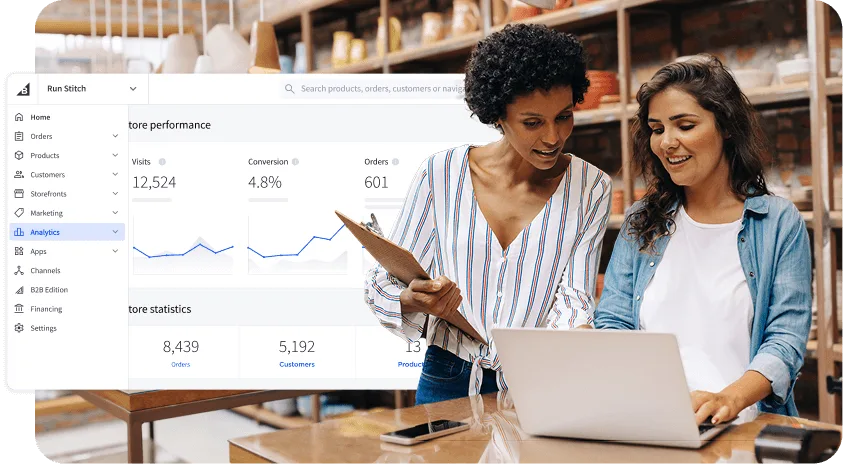
Find your favourite features.
Explore all of the capabilities of the BigCommerce platform.
What is SaaS ecommerce?
With a SaaS ecommerce platform, you’re receiving a solution via the internet that’s most often cloud-based, rather than locally installed.
Typically, you pay a monthly subscription to gain access to the platform, which the provider hosts on their servers. This subscription usually includes a number of features, like:
Store and site templates
Comprehensive out-of-the-box features
Add-ons and integrations with other ecommerce and marketing tools
The other platform option businesses often choose is open-source ecommerce platforms, like Magento. These types of solutions may not have the upfront or ongoing subscriptions of SaaS ecommerce, but require finding your own hosting, building your own site, and maintaining any updates.
Benefits of SaaS ecommerce solutions
An ecommerce platform should give business owners the tools to focus on expanding their product catalogue, growing their customer base, and freely experimenting with messaging and beyond.
SaaS ecommerce solutions can provide the perfect ecosystem to make those goals happen, bringing a number of additional benefits to the table.
Fast setup.
Ecommerce SaaS platforms can help brands get to market quickly, taking the technical burden off store owners and delivering a quick setup. This speedy setup can stem from a few things, including:
Customisable templates or ecommerce website builders
User-friendly interfaces and dashboards that make initial organisation easier
Immediate access to the platform with no installation required
Some SaaS ecommerce solutions are more user-friendly than others, but in general, they have you up and running faster than open-source solutions.
Low upfront costs.
In many cases, the upfront costs for SaaS ecommerce platforms is low, and in some cases, lower than open-source ecommerce. Beyond a monthly subscription fee, you’re usually only left with domain registration, which you pay yearly.
Overall, SaaS ecommerce can offer a predictable, cost-effective way to manage your ecommerce business. Much like your Netflix bill, but for your online store and with no cancelled shows.
Ease of use.
SaaS ecommerce solutions are typically more straightforward to use and manage than traditional open-source ecommerce, requiring less technical knowledge to set up (although that's not always the case).
Security.
When you subscribe to a SaaS ecommerce solution, you often buy peace of mind as well.
Many SaaS ecommerce solutions offer automatic updates for their platform, making it safer for you and your customers, while also taking that maintenance burden off your plate. Most SaaS platforms also provide PCI compliance, which is also one less thing you need to worry about.
Scalability.
Cloud-based SaaS solutions run on the provider’s servers. If your business is growing, and with it your customer base and site traffic, a SaaS ecommerce platform can grow with it.
Many providers also offer various tiers of plans, making it possible to add more user seats if necessary. Again, in a financially predictable way.
Customer support.
As part of your subscription, many SaaS ecommerce companies will provide ongoing support. This can range from phone or live agent support, to a ticketing system.
Keep in mind: The level of support offered by a SaaS ecommerce provider can vary, and may not be as thorough and awesome as the wide range of services BigCommerce offers its customers.
Customisation with headless commerce.
Headless commerce makes it possible to customise the front and backend of your store and site separately. While some open-source SaaS platforms offer a headless experience, it’s far more common in the SaaS space.
For instance, with BigCommerce, you can easily customise the frontend shopping experience of your online business without having to make numerous backend changes. And, vice versa.
Third-party application integrations.
Most ecommerce SaaS solutions support third-party integrations and plugins. These integrations can help you expand the capabilities of an ecommerce platform even further without having to replatform.
For example, some common integrations found in BigCommerce include:
Order management systems and automation
POS hardware integrations for in-person sales
Enterprise resource planning (ERP) to help with business management
While open-source SaaS can support integrations, they often entail more technical and developer-heavy work on your end. With a SaaS solution, integrations are far more likely to work straight out of the package.
There's a lot to love ❤️
Watch a demo to see the BigCommerce platform in action.
SaaS vs. open-source ecommerce
Depending on your in-house resources, especially where developers are concerned, open-source and SaaS ecommerce platforms can look similar.
SaaS ecommerce: leverages APIs to provide flexibility and customisation.
Open-source ecommerce: gives you access to the entire inner-workings of the platform — provided you have capable developers.
While both routes provide a high level of flexibility and customisation options, there are numerous differences between these offerings.
Cost.
In many cases, cost is a big differentiator between the two. Keep in mind that every ecommerce platform has a unique pricing structure. Some open-source platforms are free (costs come from adding apps and channels) and others charge fees based on specific variables. This is the same for SaaS ecommerce solutions so it’s important to understand the costs involved so you’ll know what to expect after you sign on the dotted line..
SaaS ecommerce costs.
No two SaaS ecommerce platforms are the same, but more often than not, their costs include:
Fixed payment, typically on a monthly subscription basis.
Domain registration costs, paid once per-year (or longer if you opt for it).
Optional add-ons or higher-tier subscription plans.
Again, the above subscription usually comes with the added benefit of not worrying about having to upgrade hosting, hire developers when security updates are required, and so on.
Open-source ecommerce costs.
Open-source ecommerce costs, like SaaS platforms, can vary. Some have an upfront licencing cost, some are free. Even those that are free will include the following costs:
Monthly hosting costs that increase as your demand does.
Developer costs, whether ongoing or in the event of updates and compliance requirements.
SSL certificates, paid yearly.
Premium plugins or integrations to add functionality.
Designer costs if site customisation is wanted.
If you have an in-house developer and design team, or a high technical knowledge yourself, the above costs can be mitigated in some instances. Otherwise, you’re looking at numerous costs that can quickly add up.
Security.
Security is crucial to ecommerce success. When a customer shops with you, they’re trusting that you’ll protect their address, credit card info, and more. This is another area where the two ecommerce paths differ.
SaaS ecommerce security.
Typically, a SaaS ecommerce provider will manage your site’s security and updates, including PCI compliance. They also usually include automatic updates for any added functionality or usability improvements.
While you still have to do your part to protect customer data, an SaaS ecommerce platform can play a big role in protecting customers.
Open-source ecommerce security.
If you opt for an open-source platform, remember that it will be your responsibility to meet PCI compliance standards and maintain the security of your site.
This means manually staying on top of:
PCI and GDPR compliance
Ensuring your SSL is updated
Maintaining a secure firewall
Monitoring your network
Like development and design, the above may require hiring specialists if you don’t have the knowledge in-house.
Installation.
Installation is one of the biggest differentiators between these two ecommerce routes, and depending on your in-house team and technical know-how, a strong area to consider if torn between open-source and SaaS.
SaaS ecommerce installation.
Installation isn’t a concern with SaaS ecommerce. Instead of installing the platform on your own systems or network, you join the provider’s platform and gain access from your web browser. No backend installation or fussing over system configurations.
Open-source ecommerce installation.
Open source software is often free to download and install. But, the installation process itself can vary, requiring technical prowess before you can begin setting up your online store.
Also, keep in mind you’ll have to manually handle updates after installation.
Customisation.
Historically, open-source has been the winner in the customisation category. But, recent SaaS offerings have closed the gap.
Still, there are key differentiators between the two.
SaaS ecommerce customisation.
With an SaaS platform, customisation comes with some tradeoffs. Since the service provider controls the source code, the user may have less freedom to customise their site than with an open source platform.
However, SaaS ecommerce software utilises APIs, which still allow for extensive customisation. Today, most SaaS platforms offer third-party integrations, allowing merchants to tailor their ecommerce platform to meet their business needs.Even complex enterprises with equally complex workflows can find an SaaS ecommerce platform that fits their needs.
Open-source ecommerce customisation.
Open-source ecommerce solutions give users control of the source code, providing a high degree of customisation — from the product page and themes to the checkout experience.
With no restrictions, users can completely modify the website to meet their business needs and create a unique customer experience.
Unfortunately, open source platforms are also very complex, and for any technical adjustments it's best for a web developer certified in the platform to handle changes.
Maintenance and support.
Updates can and will happen, and things can and will break. The difference between open-source and SaaS is who the responsibility falls on, and whether your site goes down for a noticeable amount of time (which can be quite costly).
SaaS ecommerce maintenance and support.
It should come as little surprise that SaaS ecommerce platforms will often handle maintenance on their end, taking the burden off you. This not only results in a more secure site and time saved for you, but also reduces the chances of your site going offline.
For example, BigCommerce stores have a 99.99% uptime. We handle the updates, you handle running your business.
On top of this, SaaS ecommerce providers are more likely than open-source to have thorough support.
Open-source ecommerce maintenance and support.
Security, maintenance and ongoing support are the user's responsibility with open-source software. Since you control the software, you manage the infrastructure, updates, and any issues that come with it.
This may not be as big of a headache to some, depending on their technical knowledge or in-house developer support.
Remember: Any maintenance mishaps can result in a site outage, which is like having your business locked up for a duration of time while the plumbing is fixed. Nobody likes that, except for plumbers.
Support is also hit and miss with open-source solutions, often taking the form of forums or communities rather than official, provider-backed support.
Challenges of SaaS ecommerce solutions
SaaS ecommerce solutions bring a lot to the table, but they’re not without a couple of hurdles.
Fortunately, the two things that can hold back SaaS ecommerce solutions, are also something you can often get around by choosing the right provider.
Customisation.
The level of customisation available on a SaaS ecommerce platform varies, with some sticking purely to templates and others providing site and store builders with extensive API support.
It’s important you have a clear plan and vision for your store and brand when looking at ecommerce platforms. Think about:
Site branding and visuals
The checkout experience you want
Product page appearance and content
Customer expectations in your niche
Keep the above points in mind when shopping for different SaaS ecommerce providers, ensuring they can deliver what you need.
This is also where it’s a good idaea to sign up for a demo, giving you a chance to see the platform in action, talk about your vision and needs, and ultimately determine whether the provider is the right fit.
Lack of choice.
Some SaaS ecommerce solutions are more limited in what they support, requiring you to use certain apps, payment gateways, and so on. This can make it difficult to find a solution that’s just right for your business, without feeling as if you’re compromising.
For example, Shopify has a proprietary payment provider. They charge additional transaction fees based on the credit card, along with variable fees when using other payment gateways, and you lose access to certain features like multi-currency.
You want a solution that conforms to your ecommerce business, not the other way around.
Best SaaS ecommerce solutions
There are a number of SaaS ecommerce solutions, each with their own pros and cons. To help with your decision, here are some of the best on the market, catering to solopreneurs to startups to enterprises.
BigCommerce.
BigCommerce is a leading SaaS ecommerce platform for mid-market and enterprise brands.
BigCommerce offers the benefits associated with a SaaS solution, while also delivering a high degree of customisation and functionality more common with open-source. The end result?
Secure hosting with BigCommerce.
Comprehensive marketing and SEO integrations to help you grow.
Easy customisation with the drag-and-drop PageBuilder.
Extensive API support that enables further customisation.
Further functionality through more than 1,200 integrations with leading companies.
You might think an ecommerce SaaS provider comes with limitations. With BigCommerce, you can truly embrace the “open” side of having an SaaS ecommerce platform.
See how BigCommerce stacks up against the competition.
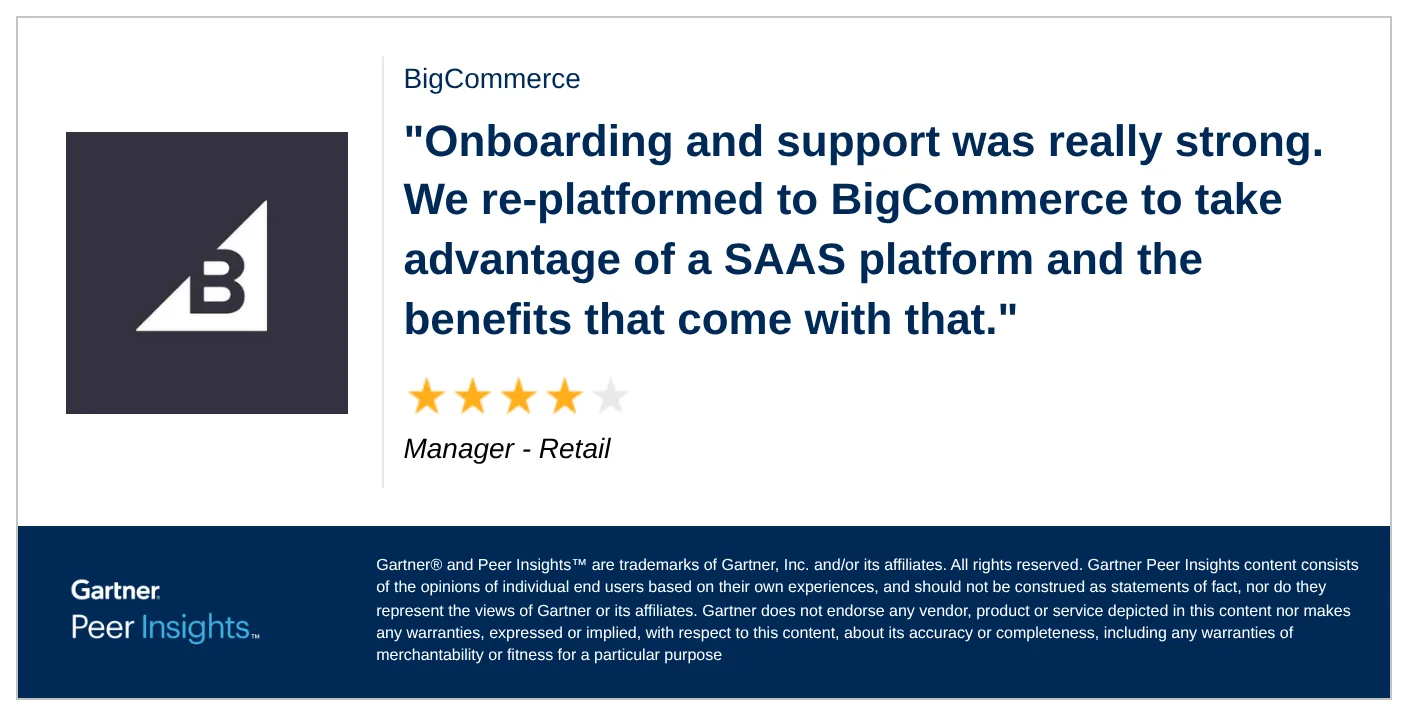
Customers consistently point to our SaaS model as a key differentiator. Read full reviews from Gartner here.
Shopify.
Shopify is a major SaaS ecommerce platform, with more than one-million retailers in the fold.
Shopify has built a reputation for its:
Intuitive interface and quick, easy setup.
A large selection of templates and drag-and-drop store builder.
One-tap payment solution, Shop Pay.
Broad payment processing integrations.
Note that Shopify does have a number of fees that can add up, making it difficult for those wanting to scale.
Volusion.
With a simple onboarding process and affordable pricing plans, Volusion represents an excellent option for small businesses and entrepreneurs.
At only $35 per month, Volusion has a low entry fee, and a number of appealing built-in features:
CRM that works right out of the box.
SEO and marketing tools to help with traffic and site optimisation.
An optional premium checkout solution with further checkout customisation.
For those who want to publish long-form content, Volusion doesn't offer a blog option. In addition, if you want to expand internationally or sell overseas, Volusion Payments are unavailable to merchants outside the US, limiting your growth.
Squarespace.
Squarespace started as a content management system primarily used by the creative community.
Today, Squarespace Commerce removes friction for omnichannel businesses selling both online and in-person, providing:
Automation that helps streamline email marketing.
Integration with social media channels.
Integrated support for product recommendations during a customer’s visit.
While Squarespace does have an app marketplace called "Squarespace Extensions," it doesn’t offer as many integrations as some competitors.
Wix.
Wix, much like Squarespace, began as a platform for quickly building websites, with a wide variety of templates and a drag-and-drop site builder.
Now, Wix has a number of ecommerce features, including:
An in-cart current converter to simplify global payments.
Product description support from AI.
A host of SEO tools and marketing automations.
If you have a large product catalogue, it's worth noting Wix doesn't support more than 50,000 products. Some users also report site testing can be difficult with Wix, as it doesn’t support multiple templates at once.
BigCommerce: A flexible SaaS ecommerce platform
BigCommerce offers an adaptable ecommerce platform that can cater to the needs of even the most complex businesses.
Historically, SaaS solutions haven’t delivered anywhere close to the flexibility of an open-source alternative. BigCommerce overcomes this, offering comprehensive out-of-the-box functionality with extensive API support.
Unlike legacy enterprise competitors, rooted in on-premise software, BigCommerce is capable of rapid upgrades, unparallelled scalability, and giving you the agility you need to stay competitive.
This has a ripple effect, delivering benefits across your business.
Resource efficiency.
Streamlined integrations, reduced administrative overhead, and simplified support processes, including reliable security and hosting (with 99.99% uptime), contribute to greater operational efficiency.
The introduction of BigCommerce's Catalyst architecture and MakeSwift visual editor offers significant resource efficiency benefits for business users. This streamlined tech stack empowers non-technical users to manage content and store layouts, reducing reliance on developers and freeing up valuable technical resources for other tasks.
Hundreds of marketing automation integrations drive further resource efficiency, streamlining abandoned shopping cart emails, automating segmentation and targeting, and beyond.
Agile growth.
BigCommerce's focus on a best-in-breed approach, rather than a closed suite of solutions, enhances its agility and that of its customers.
By partnering with leading providers in different categories, BigCommerce can quickly adopt the most advanced solutions without developing them in-house, allowing for rapid evolution of the platform's capabilities.
Our early adoption and continuous development of composable commerce, with a strong emphasis on headless architecture, allows merchants to quickly adapt their storefronts into new sales channels and customer experiences without being constrained by the limitations of a traditional monolithic platform.
This agility carries throughout the platform, too, helping you do more with the team you have while getting back valuable time.
There’s a reason Forrester Consulting found BigCommerce customers reduced the time it took to update their site or catalogues by 30-40% when using our platform.
Flexibility without friction.
BigCommerce's extensive use of APIs is the cornerstone of its customisation capabilities.
This open architecture allows merchants, agencies, and technology partners to integrate with and extend the platform's core functionalities in countless ways.
Grenson, maker of footwear since 1866, is a great example of what's possible with BigCommerce and APIs.
After leaving Magento, Grenson came to BigCommerce, largely drawn in by API support. Through the BigCommerce API layer, Grenson drove product accuracy, removed manual ERP loads, and integrated their shipping carrier management platform.
“We have definitely seen some great operational improvements; site speed is now much faster than before. It's been really good having something with the strength of BigCommerce's API layer to help us with our integrations around product lifecycle as well.”
-Ashley Hubbard, Ecommerce Manager, Grenson
Our focus on seamlessly integrating with leading third-party providers in various categories, such as payments, shipping, point-of-sale and marketing automation, gives customers the freedom to choose the solutions that best align with their specific needs and existing workflows, resulting in a truly customised and integrated technology stack.
Support at every step.
Our dedicated experts guide you through every step of your store buildout to create a custom multi-channel shopping experience.
BigCommerce offers a broad array of support that caters to every communication preference, including:
24/7 live agent support
24/7 phone support
Email support
A community-driven knowledge centre with more than 176,000 members
Don't take our word for it — read what our customers say.
The final word
There was a time when choosing between open-source and SaaS ecommerce meant choosing control versus safety.
BigCommerce stands as proof that SaaS doesn’t have to come with compromise.
Beyond providing a safe, scalable, customisable way to run your ecommerce business, BigCommerce opens the door to fully embracing omnichannel retail. An increasingly important strategy, omnichannel involves delivering a consistent customer experience across every marketplace and channel — and BigCommerce is just the SaaS solution for the job.
Learn more about omnichannel retail and how you can fully leverage the SaaS ecommerce approach.
FAQs about SaaS ecommerce
The total cost of ownership for open-source ecommerce solutions can quickly grow into the hundreds or thousands per-month, as it requires demanding hosting and SSL, manual maintenance and updates (and the developers that come with it), and professional design work.
The total cost of ownership for open-source ecommerce can increase further, depending on whether paid plugins or extensions are required, if hosting needs increase, and if in-house or outsourced developers and designers are required.
SaaS ecommerce platforms are a very viable option for large enterprise customers, as they offer predictable and consistent pricing, scalability without further in-house developer needs, extensive addons and integrations, and customisation that allows for tailor-fit branding.
Tools like Catalyst and MakeSwift make customisation accessible to technical and business users, enhancing the platform's user-friendliness and flexibility.
SaaS ecommerce isn’t without its challenges, including integration complexity and potential vendor lock-in.
Managing multiple best-in-class solutions can introduce complexity in terms of integration and maintenance. Businesses must ensure seamless communication between different systems and may require technical expertise to manage this intricate setup.
While the SaaS model offers flexibility, relying heavily on specific third-party vendors could lead to a different form of vendor lock-in. Switching providers for a critical functionality might become challenging if the integration is deeply embedded in the ecommerce ecosystem.
SaaS ecommerce stores typically require a low-to-moderate level of technical expertise to manage, largely depending on the platform and the degree to which a business wants to customise it.
For example, BigCommerce requires a low-level of technical expertise right out of the box, but enables HTML, CSS, API customisations, and more for those with more technical experience.
SaaS ecommerce platforms often push security or feature updates through a cloud-native structure, usually in phases, enabling automatic updates without interrupting service. This makes it possible for ecommerce businesses using a SaaS ecommerce platform to maintain maximum store uptime while ensuring their platform is secure, up-to-date, and compliant.
For instance, BigCommerce delivers a secure, PCI-compliant experience while maintaining a 99.98% uptime.
It's important that, before entering a contract with a SaaS ecommerce solution, businesses clarify that they will own customer, inventory, product, transaction, and financial data. This is opposed to the contract only giving the business access to the data, rather than ownership.
Ensuring the business has ownership of the data, not merely access, allows them to take it with them should they choose to move platforms or close their account with the SaaS ecommerce platform.
⏰ Isn't about time that you evaluated your ecommerce platform?
Request a demo to see how the BigCommerce platform is different.