






Written by
Lance Owide
B2B Ecommerce AI
Get The Print Version
Tired of scrolling? Download a PDF version for easier offline reading and sharing with coworkers.
A link to download the PDF will arrive in your inbox shortly.
Key highlights
AI accelerates B2B ecommerce growth and brings competitive advantages by reducing manual work and enabling smarter, more scalable operations.
Digital maturity determines AI success; clean data, connected systems, and clear workflows matter more than tools alone.
Agentic commerce moves AI from reactive support to autonomous execution across quoting, ordering, and service.
The biggest AI gains come from operational relief, not experimentation or one-off use cases.
Successful B2B organisations pair AI with human oversight, governance, and long-term investment.
Business school faculty will look back at the era of Open AI and conclude that, quite simply, artificial intelligence (AI) revolutionised digital commerce.
Jake Cook, CEO of Tadpull and a Harvard professor, calls AI a “platform shift” similar to broadband, mobile, or even the internet in a recent B2B Bites podcast episode.
Artificial Intelligence in ecommerce involves various technologies like data mining, natural language processing (NLP), machine learning, and deep learning, all working together to transform how online businesses operate.
AI tools are specifically trained using large language models (LLM). These models are limited only by a human’s ability to prompt them to answer a question or solve a problem. AI can find patterns in your B2B data and make sense of them in seconds, helping to drive more efficiency while reducing the manual effort it would take to analyse extensive data.
In the long term, AI can potentially be a “force multiplier for labour,” Cook said, particularly for manufacturers and distributors with large product catalogues and complex customer needs.
And with the advent of agentic commerce, not only will shopping evolve with the help of AI models; the entire customer experience has the potential to be enhanced.
The core problem for why AI matters now in B2B ecommerce can be distilled down to growing complexity, rising buyer expectations, and operational strain.
Instead of viewing AI as a “silver bullet” to fix problems, think of AI as a response to scale and efficiency challenges. The most successful B2B businesses take an honest look at their digital maturity, and adopt AI tools that offer relief from outdated processes, laying a better foundation for long-term growth.
But we’re just getting started!
We’ve compiled some of the takeaways from this podcast session — keep reading to learn what host Lance Owide gleaned from this eye-opening chat with Jake Cook.
Discover How AI is Transforming the Customer Experience
AI is quickly reshaping the landscape of ecommerce. Learn how you can prepare for the next wave of AI commerce.
How AI accelerates digital maturity
For businesses looking to “do more with less,” AI tools and applications are quickly becoming available that aid in a few key ways, including:
Delivering hyper-personalised customer experiences
Optimising operations (like inventory and logistics)
Enabling dynamic pricing strategies
Automating tasks
This can help drive efficiency, enable better decision-making, boost conversions, and help build stronger customer loyalty.
And with agentic commerce, businesses can now be predictive instead of reactive, anticipating customer needs faster than before thanks to advanced data analysis and machine learning.
With all of the excitement around the possibilities, it’s important to take a step back before broadly incorporating AI into your workflows and assess the current state of your business’s digital maturity.
Digital maturity is essentially how effectively a business uses its technology, data, and processes to reduce friction for both buyers and internal teams. This means looking deeper into the processes you have put in place, what tools you’re already using, and assessing the resources needed to take on new technologies.
Organisations use frameworks and models (such as those from BCG or Google/BCG) to benchmark themselves across dimensions including strategy, data, technology, and customer experience.
As online shoppers continue to evolve their expectations for ecommerce — including expecting fast, low-effort, and reliable customer experiences — it’s important for operations to be able to support that. If your team can’t support these expectations and instead “fill the gaps” themselves, not only will it add extra strain to your team’s shoulders, but shoppers will feel the friction, as well.
Focusing on digital maturity helps alleviate and reduce that burden, connecting your systems, automating manual work, and removing the blockers that slow everyone down.
There are many ways your business can leverage new technology, and it helps to know your current digital maturity before you blindly start adding new tools into the mix. We’ve made it easy to assess your business so you can begin your digital transformation with the right technology that works for you.
Ebook: B2B Digital Maturity Guide
Discover your maturity level as a B2B storefront and learn how you can improve.
Agentic commerce and the shift from automation to autonomy
Agentic commerce in B2B brings AI agents directly into how buying and selling happens. These agents don’t just answer questions; they take action based on what the buyer is trying to do. Unlike traditional automations that follow rigid rules, agentic systems are context-aware and goal-driven. They understand buyer behaviour, apply contract terms, and carry out multi-step workflows across systems with little to no human involvement.
Here’s a real-world example at work: A customer buys shoes online. A basic chatbot tells the customer when their order could arrive. An agentic system can cheque inventory, apply negotiated pricing, generate a quote, and even prep the order for approval.
Its autonomy, its ability to learn from context, and its built-in governance is what makes agentic AI so different. It operates independently, adapts over time, and respects pricing rules, contracts, and approval processes.
This is especially powerful in B2B, where catalogues are complex and purchases involve multiple stakeholders. Agentic commerce shifts AI from reactive to proactive, guiding discovery, building quotes, and moving orders forward while pulling humans in only when needed. The result isn’t just efficiency, but a more scalable and intelligent approach to digital commerce.
But even the most advanced AI shouldn’t operate without oversight.
Guardrails, governance, and trust in AI systems.
In B2B workflows, AI agents need clear guardrails to prevent mistakes or unauthorised actions. That means defining role-based permissions, building in approval steps when human signoff is required, and using monitoring tools to track agent behaviour across systems and touchpoints.
Most b2b commerce platforms, including BigCommerce, are evolving to support AI orchestration in ways that ensure safety, accountability, and transparency. From agentic checkout to AI chatbots, it's crucial to build your ecommerce store with the right tools to help you keep growing and scaling your business — safely.
Where AI delivers the most value in B2B ecommerce
AI represents a seismic shift in the ways B2B companies can use data, making processes more innovative, efficient, and highly personalised.
Smarter personalisation at scale.
Predictive analytics and machine learning are subsets of artificial intelligence and represent powerful applications in ecommerce platforms. It segments B2B customers into distinct groups based on several data points. This big data is then analysed to identify patterns, anticipate customer interactions, and deliver tailored content and product recommendations.
Algolia, a company specialising in enterprise search software, conducted an in-depth study of B2B decision-makers and found that “49% of respondents selected the ability to personalise the customer experience as a top reason for choosing a search solution with AI capabilities.”
This hyper-personalised approach resonates more with customers, leading to higher customer engagement and sales.
Predictive insights for sales and demand.
AI can analyse vast data to uncover patterns and insights humans might miss. It can predict future demand for specific products or services by analysing historical sales data and B2B market trends. Marketers can use this forecasting to make more informed decisions and adjust marketing efforts, ensuring that the right products are promoted to clients at the right time, leading to higher conversion rates.
Operational relief for sales and service teams.
AI tools can automate time-consuming and repetitive tasks, giving employees time to create more strategic workflows. Cook shared the example of using AI to generate product descriptions, especially for businesses with extensive product catalogues. He said this saves time and allows employees to focus on tasks that require more complex thinking and decision-making.
Part of BigCommerce’s AI tools includes our BigAI Copywriter. B2B businesses can leverage this to write SEO-focused product descriptions and content creation that increase search engine rankings and satisfy B2B customers’ need for detailed descriptions.
AI-powered quoting also reduces the workload for sales teams, enabling quicker quotes for customers while freeing up time to focus on generating leads (or any other task your business may need to do).
Data-driven decision making.
AI can analyse vast data to uncover patterns and insights humans might miss. Cook emphasised how AI can sift through historical sales data, customer behaviour, and product information to identify trends to help you make informed decisions. For example, AI could help determine the most profitable products, optimal times to target specific customer segments, and potential supply chain bottlenecks, greatly reducing the time and effort required to maintain efficient supply chain management.
Scalability across the enterprise.
AI can enhance the speed and accuracy of tasks involving large datasets. Cook suggested using AI to write "SuiteScripts" for the ERP software NetSuite, which BigCommerce offers. Scripts like these involve automating functions within the ERP system, which often handles substantial amounts of data related to orders, inventory levels and financials, accelerating efficiencies across the enterprise at a fraction of the cost.
Enhanced customer service.
AI can provide B2B buyers with 24/7 self-service support through AI-powered chatbots like LiveChat. These chatbots can be trained on a company's product catalogue and customer service history to answer common questions, resolve issues, and even recommend products. This augmented customer support frees customer service representatives to handle more complex issues.
AI chatbots can also manage manual order tracking, streamlining the many tasks involved in keeping customers informed.
Managing customer relationships.
CRM systems are full of valuable data, but much of it remains stuck in silos. You already know which companies have visited your website and the roles of your visitors. Customer complaints? They're likely buried in your CRM, too.
A CRM tool offers insights into each step of the customer journey, so sales reps never miss a lead; marketing boosts its upsell rate, and customer service sees its Net Promoter Score (NPS) improve because issues are resolved quickly.
AI-powered ABM (account-based marketing).
Piggybacking on your CRM, you can optimise account-based marketing (ABM) by identifying target accounts that show buying intent, analysing their behaviour, and suggesting the best strategies to engage them. AI-driven ABM ensures that marketing and sales efforts are focused on high-value accounts, leading to higher conversion rates.

Get a clear view of your B2B digital maturity.
Learn key areas for improvement and actionable insights to help your business grow faster and smarter.
Examples of AI in B2B businesses
AI-powered product search.
AI technology can analyse large product catalogues and identify patterns in customer purchase history to return more relevant search results. Jake Cook highlights this benefit in businesses with "large SKU counts," such as automotive parts distributors who may have millions of products.
The ability to surface products customers are most likely to buy increases sales and decreases operating costs because the buyers are served immediately without any sales or service intervention.
Website personalisation.
AI algorithms can understand complex product relationships and dependencies, leading to intuitive and personalised marketing. Cook illustrated a helpful search experience using the example of an HVAC system.
AI can understand that specific HVAC components are interconnected and suggest related parts that humans might overlook, even when those relationships are not explicitly tagged in a traditional product recommendation engine. This capability can help customers find all the necessary parts for their projects more efficiently.
Scale product descriptions with generative AI.
Generative AI can help businesses automate tasks like writing hundreds of unique product descriptions. Improving the quality of product descriptions can lead to improved B2B ecommerce search engine optimisation (SEO) and differentiate them from dozens of manufacturer websites using the same boilerplate descriptions.
AI-powered customer journey mapping.
As a starting point, AI can provide B2B digital commerce with a blueprint for mapping the customer journey using the data they are sitting on.
The typical stages of the customer journey are awareness, consideration, evaluation, purchase, ownership, loyalty, and evangelism. Some B2B companies may have more steps depending on the complexity of their buying cycle.
AI models, like Claude, ChatGPT, and Gemini provide a blank screen to submit a detailed prompt unique to your ideal prospect’s buyer’s journey. Grab data from Google for impressions, traffic, and user attributes. Then, take your email subscriber data and social media performance. Upload it to one of these platforms and determine which gives you the most actionable roadmap.
Remember, you are training the AI tool. Your goal is to have it ingest the data and ask, “Where does it fit in the customer journey?” Rinse and repeat for every stage.
Jake told his students in this four-minute YouTube video, “Just play with it.”
Predictive analytics.
As mentioned above, AI can help businesses identify patterns in customer data to improve the user experience. Additionally, sales and marketing departments could use AI to identify customers at risk of churning and reengage them or highlight products frequently bought together, increasing average order value (AOV) across the customer lifecycle.
Supply chain and operations.
The ability to analyse vast amounts of historical data represents a gigantic leap in inventory management, planning, and pricing for B2B ecommerce businesses. With the right tools in place, AI forecasting can optimise inventory planning, giving you greater insights (and the ability to step in and stop disruptions before they happen). AI automation can project seasonal and regional sales, keeping the pulse on demand and allowing management to adjust real-time dynamic pricing.
Challenges associated with B2B ecommerce AI
As we enter this new Intelligence Age, we need to be aware of the uses and abuses made possible by artificial intelligence. Here are some of the challenges associated with artificial intelligence in B2B ecommerce, based on the speakers' discussion in the podcast.
Inaccurate or wrong information.
AI models can lie; when this happens, it’s called “hallucinating.” Because it is a machine, there’s no malicious intent. Artificial intelligence is made on models with three imperatives: harmless, helpful, and truthful. Sadly, lying gets third billing. So, caveat emptor — cheque that your output is factual.
Cook described testing an AI model by asking it to count the number of characters in a sentence. The model returned the wrong answer, emphasising that AI systems, despite their sophistication, can still make mistakes. This underscores the importance of human oversight in reviewing and validating AI outputs.
Resistance to change internally.
B2B companies that have built their business on relational sales may only initially accept AI, even though social business channels like LinkedIn have shown them the value of a digital handshake. Digital transformation can seem daunting.
Cook compares AI to "a really eager intern that never gets tyred," highlighting its potential and need for guidance. He suggests approaching AI implementations strategically, starting with lower-risk tasks and gradually increasing responsibility as confidence in the AI's capabilities grows.
Data integration and technological immaturity.
While AI can streamline and expedite complex processes, integrating different software systems can be challenging, particularly for manufacturers and distributors who rely on customised integrations. Cook suggested that AI write code for these integrations, potentially reducing the reliance on specialised developers and accelerating the integration process, enhancing business operations and customer experiences.
Customisation needs.
The needs of B2B buyers are different from those of B2C buyers. One path to conversion is complex, while the other is straightforward. Add to the equation complex pricing models, extensive product catalogues and cross-departmental decision-making, and it becomes clear that a one-size-fits-all AI solution won’t cut it. Being close enough is not good enough for B2B decision-makers. They need a tool that can help customers configure and customise products, and that doesn’t come in a box.
Cost and resource allocation.
Like every digital commerce website, AI has fixed costs across the enterprise. Companies that don’t budget for ongoing maintenance or skimp on talent will fall behind as the Intelligence Age barrels forward. The ability to attract essential technology workers necessary to implement AI solutions thoroughly may pose an ongoing challenge.
The final word
As businesses move toward greater digital maturity, AI adoption needs to be intentional.
Leading ecommerce organisations start with lower-risk use cases, then expand as their data, processes, and teams are ready.
AI can unlock major gains in B2B ecommerce, but only when paired with the right skills, governance, and infrastructure.
In digitally mature organisations, AI powers more targeted marketing, personalised experiences, and smoother customer journeys by turning data into action.
The goal isn’t to replace people, but to augment human expertise, using AI to scale what teams do best and support long-term growth and innovation.
FAQs about AI in B2B ecommerce
Artificial intelligence in B2B ecommerce is evolving, but the benefits outweigh the challenges. Exceeding customer expectations by creating a unique and accessible solution to their problem equates to a memorable customer buying experience. Despite the length of a sales cycle or product complexity, the power of AI lies in its ability to manage customer relationships seamlessly. Bottom line: the road to profitability is delivering on customer satisfaction.
Future B2B ecommerce AI trends focus on deep integration for agentic commerce, where AI handles tasks like quotes and orders autonomously, alongside hyper-personalisation, predictive analytics for churn/demand, dynamic pricing, generative AI for content creation, and AI-powered supply chain/inventory optimisation, moving beyond basic chatbots to core operational efficiency and customised buyer journeys.
Getting internal buy-in to use artificial intelligence is no different than getting buy-in for any other technology solution. Depending on your organisation's complexity, buy-in requires knowing your audience and managing expectations.
Identify key stakeholders and present successful AI use cases in B2B commerce to lay the foundation for AI’s projected return on investment. A CTO will expect a different use case than the VP of sales. Customise your internal pitch accordingly because we all have a different understanding of how AI can help solve a problem.
AI supports sustainable B2B growth by boosting operational efficiency (demand forecasting, inventory, logistics), personalising experiences (content, recommendations), automating complex tasks (pricing, order processing), and enabling data-driven decisions for both profit and environmental sustainability, such as reducing carbon footprints through optimised routes.
It helps streamline complex B2B sales, reduces waste from overstocking, cuts energy use, and fosters customer loyalty through better service, leading to scalable, profitable, and responsible ecommerce practises.
B2B companies using AI must focus on data privacy and security, transparency and explainability, fairness and bias mitigation, and having human oversight in place. This ensures compliance with regulations (like GDPR/CCPA) and maintains trust with the public, preventing reputational damage from misuse, deepfakes, or biased decisions that could harm clients or lead to fines.
Key steps include: instituting clear data use policies, rigorous algorithm auditing, diverse training data, obtaining explicit consent, and keeping humans in control of critical decisions.
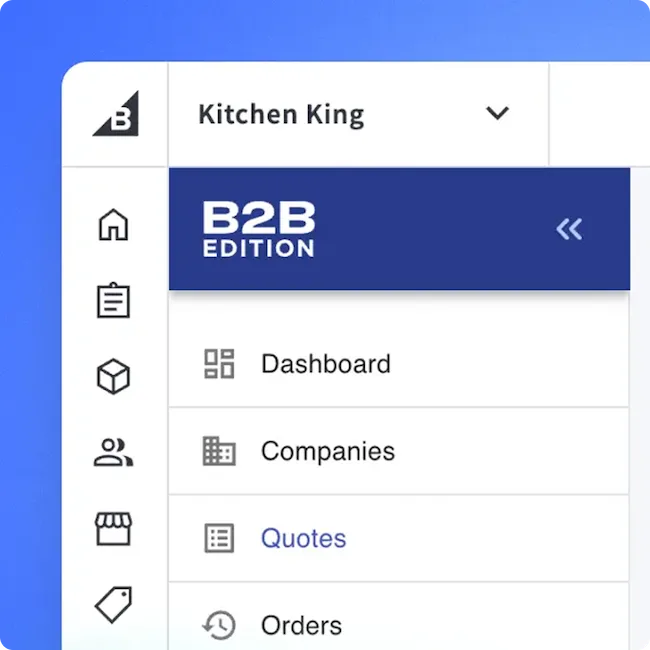
We're serious about B2B.
BigCommerce B2B Edition gives you account management and quoting tools to help your sales team get more orders.