





Written by
Haylee Clark
ERP Integration
Get The Print Version
Tired of scrolling? Download a PDF version for easier offline reading and sharing with coworkers.
A link to download the PDF will arrive in your inbox shortly.
Key highlights:
ERP integration connects ecommerce systems with back-end operations to eliminate data silos and manual data entry.
Real-time data synchronisation improves inventory management, order processing, and customer experience.
Integration can be achieved through APIs, middleware, or integration platforms, depending on complexity and scale.
Costs vary widely based on systems, customisation, and architecture — but long-term operational efficiency often outweighs upfront investment.
The right ERP ecommerce integration supports automation, scalability, and better decision-making as your business grows.
As ecommerce businesses grow, so does the complexity behind the scenes. Orders increase. Sales channels multiply. Inventory lives in more than one place. And suddenly, teams are juggling spreadsheets, duplicate data entry, and systems that don’t talk to each other.
That’s where ERP integrations come in.
An ERP integration connects your ecommerce platform with your enterprise resource planning system — syncing data across finance, inventory, fulfillment, CRM, and supply chain operations. Done right, it replaces manual work with automation, enables real-time visibility, and gives teams a single source of truth they can actually trust.
In this guide, we’ll break down what ERP integration is, why it matters for modern ecommerce businesses, common integration patterns and methods, costs to expect, and best practices to help you choose the right ERP solution for long-term growth.
What is ERP integration?
At its core, ERP integration is about making different systems work as one.
An ERP system is designed to manage core business processes — financials, inventory, supply chain management, and customer relationship management. But an ERP on its own doesn’t operate in a vacuum. It needs to connect to ecommerce platforms, CRMs, payment gateways, shipping providers, and other ecommerce systems to be truly effective.
ERP integration enables those connections. It automates data exchange between systems so that orders, stock levels, customer data, and financial data stay aligned — without constant human intervention. When an order is placed in an online store, the ERP updates inventory in real time, triggers order fulfillment, and records revenue automatically.
For ecommerce businesses, ERP integration often becomes the backbone of operational efficiency — especially as transaction volume, product complexity, and omnichannel selling increase.
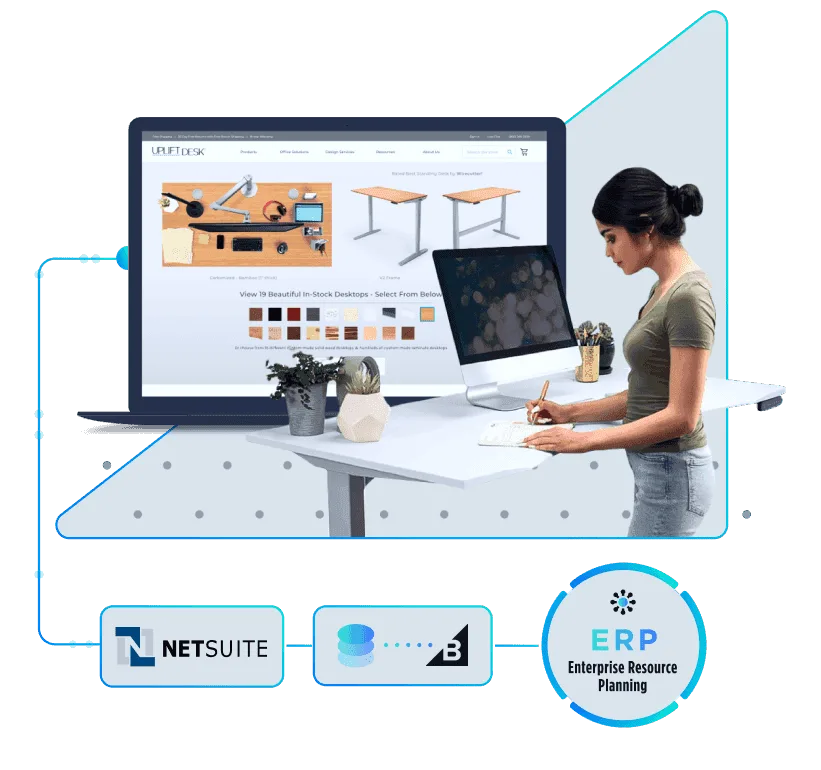
Your ERP. Our ecommerce engine.
Bring your data together. BigCommerce integrates with major ERPs to streamline operations.
Why ERP integration matters for ecommerce
As ecommerce businesses scale, disconnected systems become a bottleneck. ERP integration solves that by centralising data and streamlining workflows across the organisation.
Centralised data and fewer silos.
Data only creates value when it’s accessible and reliable. Without integration, customer data, financial data, and product information live in different systems — creating silos that slow teams down and introduce risk.
An ERP integration brings those data flows together, creating a unified view that supports informed decisions across stakeholders.
Automation across business processes.
ERP integrations replace repetitive tasks with automation. Instead of manual data entry or batch uploads, integrated systems update continuously — 24/7.
That automation supports smoother workflows across:
Order processing and order fulfillment
Inventory management and real-time inventory visibility
Financial reporting and forecasting
Customer relationship management (CRM)
Improved customer experience.
Customers don’t see your systems — but they feel the impact. Accurate inventory levels prevent stockouts. Faster order tracking improves confidence. Real-time data enables personalised, omnichannel experiences that meet modern expectations.
And those expectations are high. According to recent research, 86% of U.S. consumers say they’d be willing to switch brands if they know they can get a better customer service experience elsewhere. In ecommerce, ERP integration plays a quiet but critical role in meeting that bar — ensuring the right products are available, orders move smoothly, and customers aren’t left waiting or guessing.
Reduced human error.
Even the most careful teams make mistakes when processes rely on repetitive manual input. ERP integrations reduce that risk by syncing data automatically across different systems, improving accuracy and trust in reporting.
Common challenges with ERP integration
ERP integrations deliver powerful benefits — but they’re not plug-and-play. Understanding the challenges upfront helps teams plan more effectively.
Complexity across systems.
Most ecommerce businesses operate within a patchwork of tools: cloud-based ecommerce platforms, legacy on-premise ERP software, CRMs, and third-party providers. Integrating systems like NetSuite, SAP, or Microsoft Dynamics with modern ecommerce solutions requires thoughtful architecture and planning.
Cost and scope creep.
ERP integration projects often fall into the “unknown unknowns” category. Hidden dependencies, undocumented workflows, or data inconsistencies can surface late — driving up costs and timelines if they aren’t accounted for early.
Data quality issues.
Integration exposes the reality of your data. Duplicate records, inconsistent product information, or outdated inventory levels can create problems once systems are synced in real time. Data cleanup may not be glamorous, but it’s essential.
The most common ERP integration patterns
While no two integrations are identical, most ecommerce ERP integrations follow a handful of proven patterns that shape how data flows.
Migration ERP integration.
This pattern moves historical data from one system to another at a specific point in time — often during an ERP replacement or platform consolidation. Migration integrations focus on accuracy and completeness rather than ongoing synchronisation.
Broadcast pattern.
In a broadcast pattern, one system sends updates to multiple destinations in real time. For example, pricing or product updates in an ERP platform can instantly flow to multiple online stores or marketplaces, keeping data consistent across sales channels.
Aggregation pattern.
Aggregation pulls data from multiple systems into a single destination, typically for reporting or analysis. This approach supports forecasting, financial oversight, and decision-making without duplicating data across platforms.
Bi-directional synchronisation.
Bi-directional sync allows systems to exchange updates continuously. Inventory changes in the ERP update ecommerce systems, while orders placed online update the ERP in real time. This pattern is common in high-volume ecommerce environments.
Correlation pattern.
Correlation syncs only specific datasets shared between systems. It’s often used to limit scope and complexity while maintaining consistency where it matters most.
Your ERP. Our ecommerce engine.
Bring your data together. BigCommerce integrates with major ERPs to streamline operations.
ERP integration methods
How you integrate matters just as much as what you integrate. The right method depends on your business needs, scalability goals, and technical resources.
Integration platform as a service (iPaaS).
iPaaS solutions are cloud-based integration platforms designed to connect ecommerce platforms, ERP software, and SaaS tools using prebuilt connectors and configurable workflows.
They’re flexible, scalable, and well-suited for ecommerce ERP integration — especially for businesses planning to add new systems or sales channels over time.
Point-to-point integration.
Point-to-point integrations connect systems directly with one another. This is effective for simple integrations where there are only two platforms involved, although this is becoming less and less common in modern integrations.
Enterprise Service Bus (ESB).
ESBs act as centralised messaging hubs, routing and transforming data between systems. They’re commonly used in on-premise environments, but can struggle to support modern cloud-based ecommerce ecosystems.
How much does ERP integration cost?
ERP integration pricing varies widely — and for good reason. Every integration reflects a different combination of systems, complexity, and business requirements.
Costs are influenced by:
Number of systems to integrate
ERP platform (e.g., NetSuite, SAP, Microsoft Dynamics)
Ecommerce platform complexity
Custom workflows and data models
Middleware or integration platform fees
On-premise vs. cloud-based ERP architecture
Internal vs. external implementation resources
For SMBs, ERP integration projects often start in the mid–six figures. Enterprise integrations can reach seven figures or more. While the upfront investment can be significant, long-term gains in automation, operational efficiency, and scalability often justify the cost.
ERP integration best practices
A successful ERP integration is rarely about the technology alone. The difference between a smooth integration process and a painful one usually comes down to planning, alignment, and execution.
These best practices help ecommerce businesses reduce risk, control costs, and build integrations that last.
Involve key stakeholders early and often.
ERP integration affects far more than IT. Finance teams rely on accurate financial data. Operations teams need dependable inventory levels. Customer-facing teams depend on real-time order tracking and customer information.
Bringing stakeholders into the conversation early ensures the integration reflects real business needs — not just technical assumptions. Ongoing communication also helps manage expectations and reduces friction as workflows change.
Have a clear integration plan in place.
ERP integrations are complex, and vague goals are a recipe for scope creep. Before development begins, teams should clearly define what success looks like.
A strong integration strategy outlines:
Which systems need to be connected and why
Which data flows are mission-critical versus “nice to have”
How automation will streamline specific workflows
How the integration will scale as order volume and sales channels grow
This clarity helps teams prioritise functionality, control costs, and avoid overengineering.
Clean up your data prior to integration.
ERP integration doesn’t fix bad data — it spreads it faster.
Before integrating systems, audit product information, customer data, inventory records, and financial data. Resolve duplicates, standardise naming conventions, and align data structures across different systems. While this step takes time, it prevents far larger issues once data begins flowing in real time.
Security is paramount.
ERP integrations often involve sensitive financial data and customer information. Security should be foundational, not an afterthought.
Ensure encryption is used for data at rest and in transit, access controls are clearly defined, and third-party providers meet enterprise-grade security standards. A secure integration protects both your customers and your business.
The final word
ERP integrations turn fragmented systems into a connected ecosystem. For ecommerce businesses, that connection enables automation, real-time visibility, and the operational confidence needed to scale without chaos.
The right ERP integration doesn’t just streamline workflows — it improves customer satisfaction, supports better forecasting and decision-making, and prepares your business for future growth across channels, markets, and technologies.
Whether you’re integrating NetSuite, SAP, Microsoft Dynamics, or another ERP platform, investing in a thoughtful ERP integration strategy is one of the most impactful steps you can take to build a resilient ecommerce operation.
FAQs about ERP integration
An ERP is a connector. It’s software that ties multiple systems and processes together to enable them to share data between disconnected platforms. It brings disparate apps like procurement, supply chains, human resources and accounting under one roof, providing a unified platform for business functions.
ERP applications enable businesses to reduce silos and work as one company instead of multiple isolated islands. Enabling data sharing offers new opportunities for business intelligence and processes are sped up, helping you to keep pace with the speed of business. Real-time data means you can better react to market changes and optimise the customer experience, positively impacting the bottom line.
The benefits of ERP integration far outweigh the initial cost.
API-based ERP integration connects systems directly using application programming interfaces (APIs). This approach works well when you’re integrating a smaller number of systems or need custom, lightweight data exchanges.
Middleware and integration solutions sit between systems and manage data flows at a higher level. They’re often better suited for complex ecommerce environments because they can:
Orchestrate multiple systems and data flows at once
Handle data transformation and validation
Monitor integrations and flag errors automatically
Scale as new sales channels or systems are added
For growing ecommerce businesses, middleware typically offers more long-term flexibility and resilience than direct API connections alone.
Peak seasons expose weak systems quickly. When ecommerce platforms and ERP systems aren’t integrated, teams are forced to rely on manual workarounds just as order volume spikes.
With ERP integration in place, scalability improves because:
Orders flow automatically into back-office systems
Inventory levels update in real time across sales channels
Fulfillment and order processing stay aligned even under heavy load
The result is fewer bottlenecks, faster response times, and a more consistent customer experience when demand is highest.
Real-time inventory synchronisation is one of the most valuable — and most challenging — aspects of ERP integration.
Common issues include latency between systems, mismatched data structures, and temporary system outages. These challenges are typically addressed through:
Clear ownership of inventory data (which system is the source of truth)
Strong error handling and retry logic
Ongoing monitoring to catch discrepancies early
When designed thoughtfully, real-time inventory becomes a strength rather than a risk.
AI adds an analytical layer on top of ERP data, helping teams move from reactive reporting to proactive insights.
In ecommerce environments, AI can help:
Improve demand forecasting and inventory planning
Detect anomalies in supply chain or fulfillment performance
Identify patterns in customer behavior across sales channels
Instead of manually analysing reports, teams can use AI-driven insights to make faster, more informed decisions.
Choosing the right ERP system is about more than current functionality — it’s about adaptability.
Key qualities to look for include:
Cloud-based architecture that supports scalability
Strong API support and integration capabilities
Proven ecommerce ERP integration options
Robust data security for customer and financial data
Just as important, the ERP platform should evolve with your business — supporting new workflows, integrations, and business models without requiring a full rebuild.

Find your favourite features.
Explore all of the capabilities of the BigCommerce platform.