- Start & Build

Product Overview
What you can do with BigCommerce.
Agentic Commerce
 AI-powered solutions for growth.
Design Your Store
Build your store with or without code.
Apps & Integrations
Over 1,200 apps to help you grow.
Migrate to BigCommerce
Switch from Shopify, Woocommerce, Salesforce, Magento, and more.
- Launch Services
Overview
Chart your path to success with specialised services.Implementation Project Management
Experts to ensure you launch on time and under budget.Solution Architecture
Seasoned advisors to help you best design your store.Data Migration & Optimisation
Expertise on a clean and clear path to migrating your data.Enterprise Launch Package
Personal training on how to set up and launch your BigCommerce Store.

Professional Services Blog Series
Get to know our teams and how they support your success in this Q&A series.

The Global B2B Buyer Behavior Report
This in-depth report provides actionable strategies to help you sell more online.
The Boring Work That Actually Wins in B2B Commerce

Create your store and start selling today.
Create your new website.
See if the BigCommerce platform is a good fit for your business.
No credit card required.

Written by
Anita J. Temple27/05/2026
Commerce Live 2026 B2B Sessions Highlights
Every commerce conference promises transformation. Every keynote mentions AI. And yet, when you sit down with the executives who are actually running B2B companies, the ones managing million-SKU catalogues, fax-enabled order flows, and ERPs that predate the iPhone, a different story emerges. It's not a story about revolution. It's a story about fundamentals.
That was the common thread throughout all the B2B-focused sessions at Commerce Live 2026. Across keynotes, breakout sessions, and panel conversations, the most resonant moments weren't about what's coming next. They were about the unexciting, often difficult work that separates B2Bs that grow from those that stall — and the partners who help them get there.
You probably have a process problem, not a technology problem
If there's one piece of advice that echoed through the conference, it came from Joe Cicman, Principal Analyst at Forrester: before you buy any technology, draw your business out on a whiteboard.
“Prescription without diagnosis is malpractice,” Cicman announced during the B2B Commerce Trends panel. “I get people calling and asking me, “Joe, what's the hot new trend? What pill can I take to make me run faster and fix my eyesight?” What I say is, “Look, you don't want to take your neighbour's medicine just because she's feeling better today.””
He shared a story about a state-run Department of Transportation that asked for help finding a new procurement platform. They told him they specifically needed one that worked with state agencies because their current system caused invoicing problems which caused encumbrance problems. After months of digging (which included calling in an expert process mapper), Cicman’s team discovered a budget process that no one in the organisation even knew existed — an informal workaround that had been creating the invoice problems for years. His point? That’s why you draw out your businesses and your processes first. “We could have bought 15 procurement systems and it wouldn't have solved the problem.”
This is a pattern that constantly shows up in B2B. A manufacturer with an ecommerce search function that only works if you already know the exact SKU. Customers leaving order notes like “I ordered this, but I actually want this — can you swap it?” on every single transaction. The thing B2Bs need to realise (before investing in a solution) is that technology cannot solve issues like these. They're process failures wearing technology's clothes.
The good news, Cicman offered, is that clarity about the problem changes everything.
“When you can go in front of your execs and say, 'Remember this problem that's been a gnat in the attic for years? Here’s the causal traceability of where it comes from.' Then you'll never have a problem justifying the technology. You'll have the problem of being asked for more than you can deliver. And that's a solvable problem.”
— Joe Cicman, Principal Analyst, Forrester
His closing advice to the room was deceptively simple: draw your business on a whiteboard, take a picture, share it with your partners, and find someone who cares about it as much as you do.
Data is not a project. It's infrastructure.
The Data as Infrastructure session made a point that should be printed and taped to the wall of every ecommerce team in B2B: “Data is the problem on every migration.”
Even though the audience laughed, Sarah Schmidt, Chief Operating Officer of Mira Commerce, wasn't joking when she said it.
“Data used to be something you layered in over the top. It used to be an add-on. Now it's the baseline to being able to operate.”
— Sarah Schmidt, COO, Mira Commerce
This shift has caught a lot of B2B businesses flat-footed. Companies invest heavily in front-end experiences — new storefronts, personalisation, better search — without having the backend data to support them. The result is a gap that no amount of UI polish can close. As Schmidt put it plainly: “You can't search for something that's not there.”
Darren Greene, Global Marketing Director of DESTACO, framed the problem with an analogy that stuck: “Data is like oil. You can get it out of all these nooks and crannies all over the place, but until you really refine it, it can't fuel your growth. It's just there.” In B2B, that crude data typically lives in ERPs, engineering systems, marketing materials, and the heads of sales reps. Rarely is it in one place, and in the language customers actually use.
That last point is critical. Greene offered up an example: his team discovered that the same clamp could be found on a workbench, on the ladder rack of a fire truck, or holding a door closed in an industrial plant. This created three completely different use cases, which meant three different ways a customer might search for it. Getting that context into the product data — and speaking the customer's language rather than internal shorthand — is the boring work that drives findability and conversion.
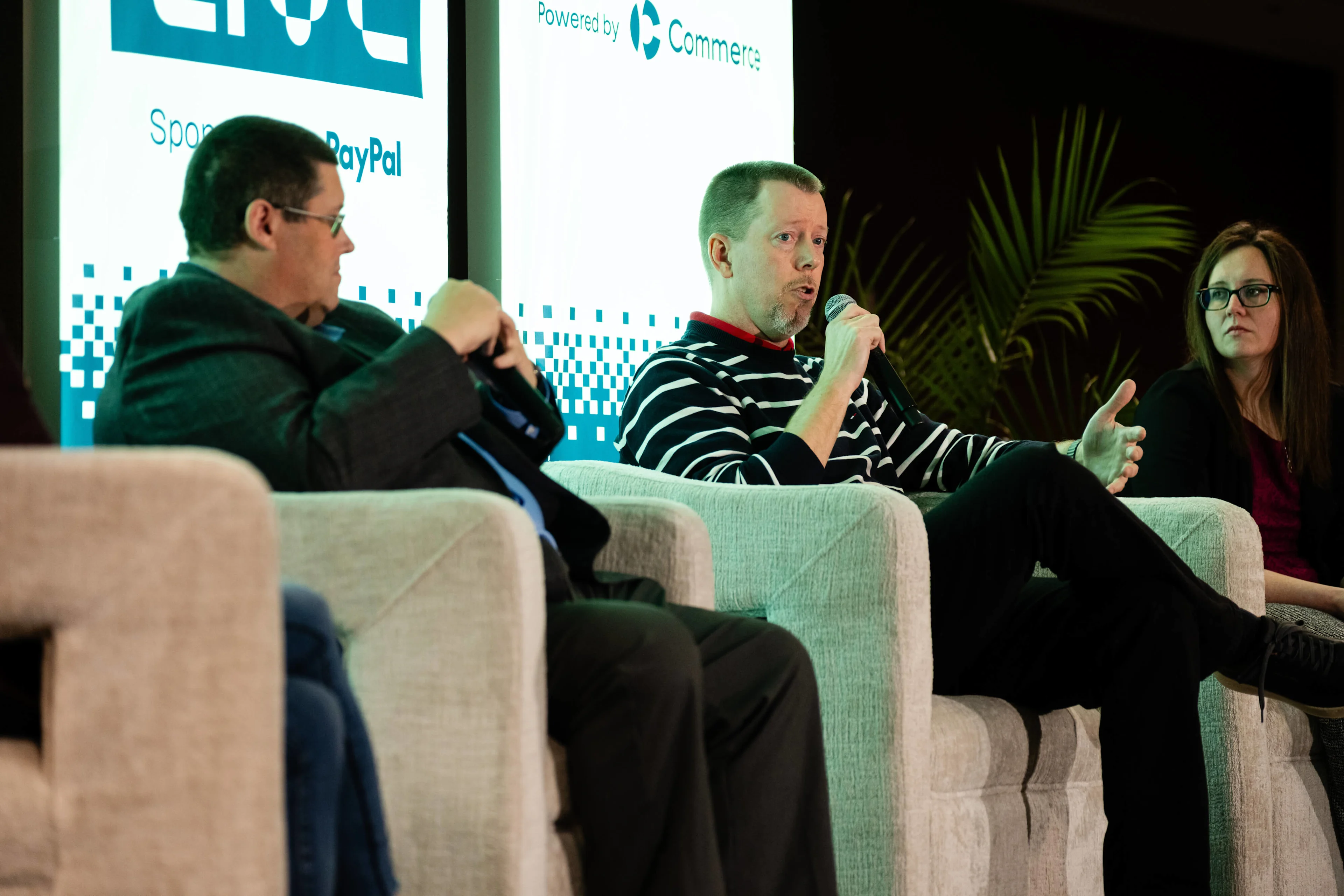
From left: Darren Greene, DESTACO; Traver West, Pickleball Central; Sarah Schmidt, Mira Commerce
So where do you start?
Traver West, Vice President, Platforms & Technology at Pickleball Central, gave the most actionable answer of the session: “Figure out your top 5% of bestselling products. Consider how your customers search for and use those products. Ensure all of that language is throughout the description, the meta information, everything on the product page.” Five percent of a catalogue might not sound like much, but it's momentum, and in B2B, momentum is rare.
Schmidt of Mira Commerce, shared a triage framework to help teams that feel overwhelmed. Schmidt said to think in three buckets: product data, customer data, and order/transactional data. Then, start with the most critical questions: can your customer actually check out? Do you have pricing? Do you have inventory?
“Get the baseline in place first, then work outward. And don't over-rotate to AI in the meantime. If someone checked out with a blue couch and you sent them a gray couch, it doesn't matter that they had a great experience finding their perfect couch.”
— Sarah Schmidt, COO, Mira Commerce
The operational layer nobody demos
Some of the most meaningful product news that came out of Commerce Live wasn't about flashy customer-facing features. It was about removing friction from the back office — the part of B2B commerce that, when it breaks, costs real money.
In the keynote, Commerce Momentum: Product Vision & Roadmap for What’s Next,Lance Owide, Vice President of B2B at Commerce, highlighted two product announcements, specifically designed to support B2B operations.
The first: BigCommerce's Purchase order agent, now live in Alpha. The statistics behind it tell the story: 75% of B2B purchase orders are still delivered by email and fax. Manual processing can cost up to $500 per order on average. Manual entry errors compound the problem further. The Purchase Order Agent uses AI not as a headline, but as a back-office workhorse — extracting PO data, validating it against catalogue, customer-specific pricing, inventory, and address books, before surfacing alternatives when a product isn't available so the sale isn't lost.
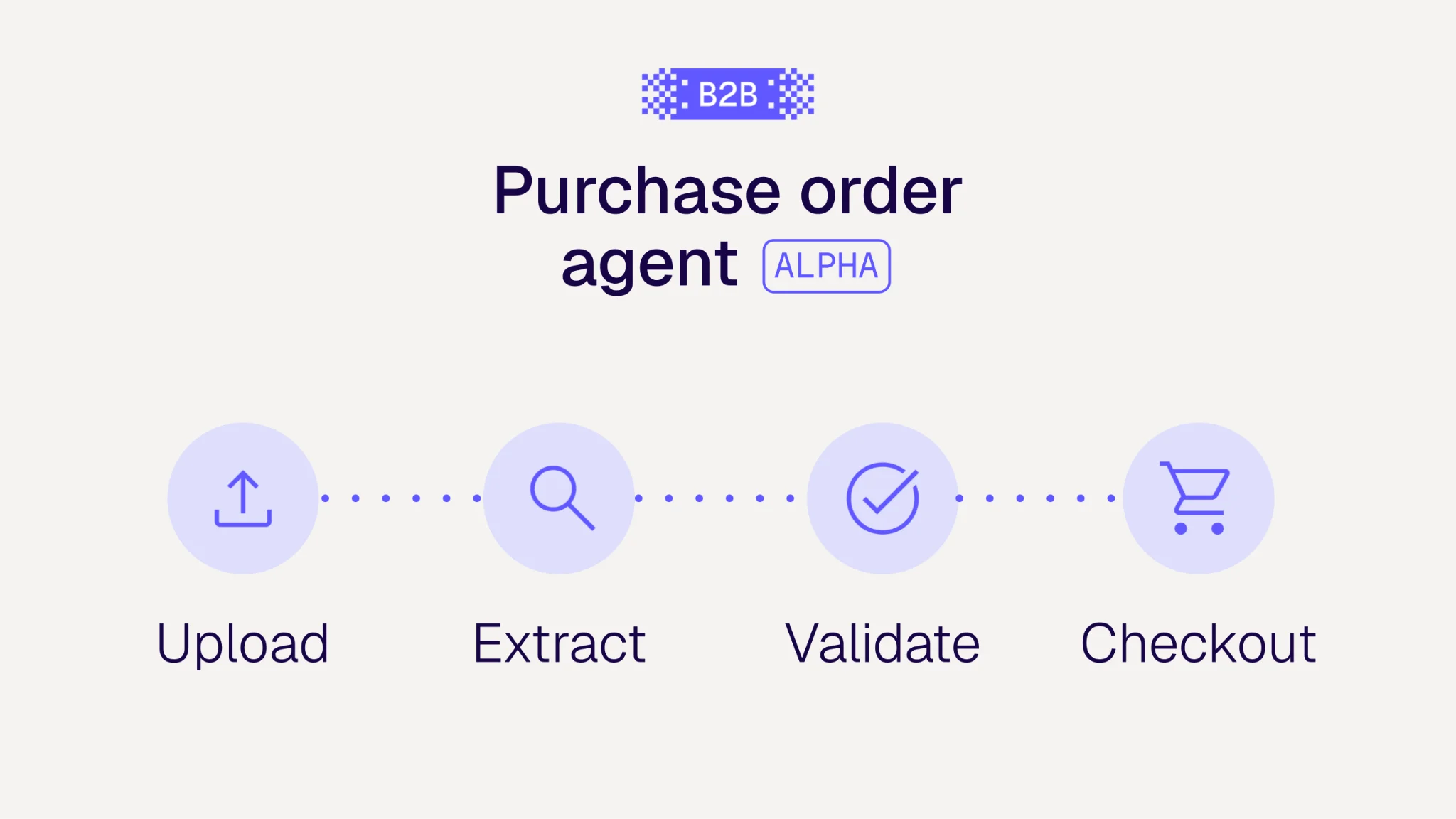
BigCommerce’s Purchase Order Agent is designed to support seamless back office B2B operations.
The second: Cascading price lists, which just moved into Beta, was designed to solve a specific B2B problem: pricing complexity.
Many B2Bs load hundreds of price lists into their commerce platform (contracted pricing for specific SKUs, volume discounts, tiered pricing, wholesale and retail rates, etc.) and often update them multiple times a day. As Owide explained it, “In BigCommerce today, that can translate into price list explosion. You end up duplicating records across hundreds — sometimes over a thousand of price lists. They fall out of sync with your ERP and every sync cycle becomes a bottleneck, pricing updates are slower…”
Cascading Price Lists provides a simple solution. The B2B defines a primary price list and defines a fallback, then resolves pricing from there. “When we resolve pricing — on a PDP, in the cart, at checkout — we check the primary first. If the product isn't there, we inherit from the fallback. And if it's not there either, we default to catalogue price.”
“One of our merchants was managing over a thousand price lists…with just one level of fallback, they'll get down to about thirty.”
— Lance Owide, VP, B2B, Commerce
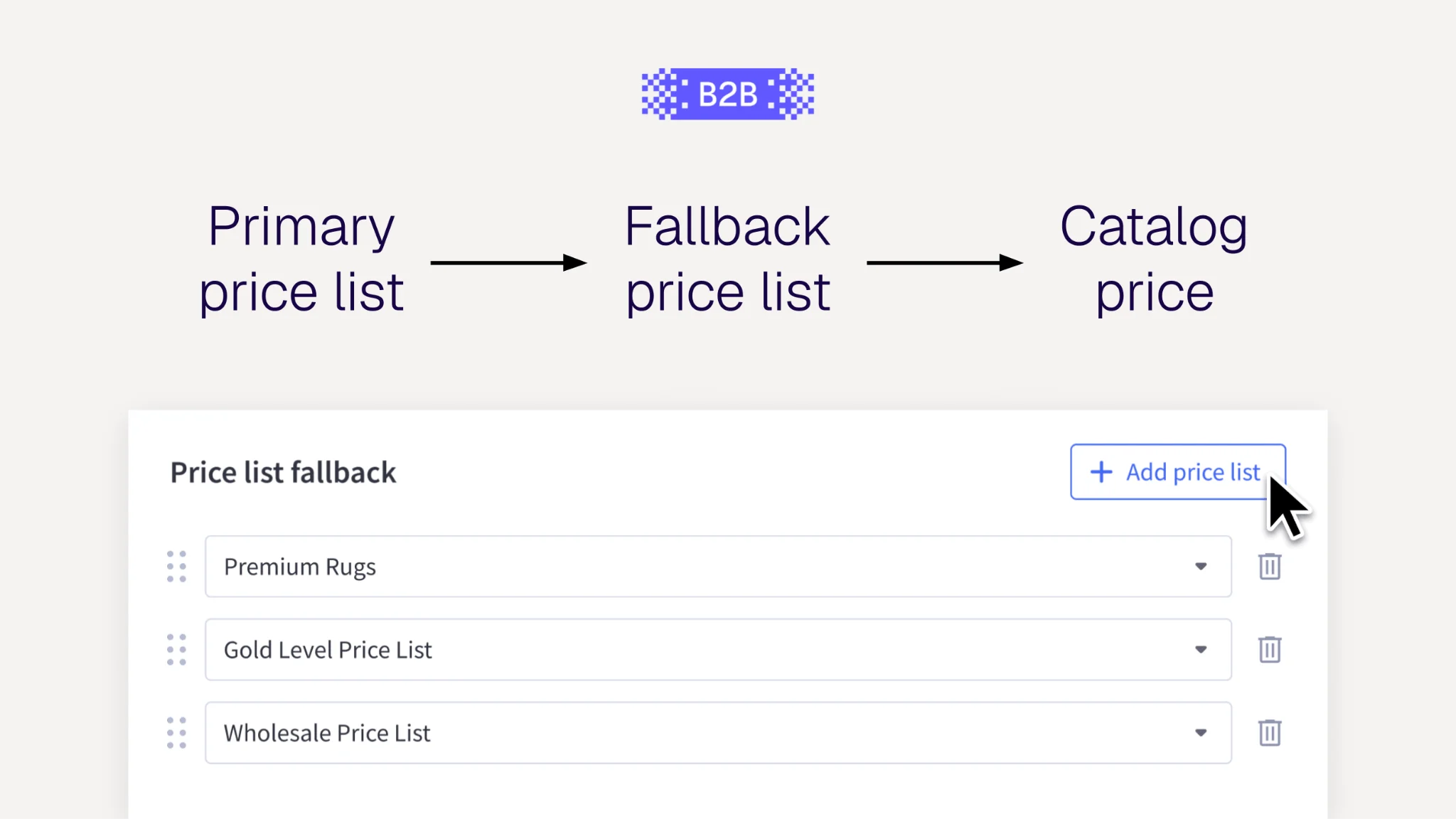
How the fallback process works in BigCommerce’s Cascading Price Lists feature .
These B2B products were not created to generate applause, they were created to give B2B businesses the operational foundation to actually scale.
Start. Partner. Trust. Repeat.
The B2B Commerce Trends panel brought together practitioners from Smurfit Westrock, Arrow Fastener, and Oldcastle - CRH Americas Building Products — businesses that span packaging, hardware, and building products. The story they collectively told wasn't about technology, it was about sequencing and partnership.
Christy Doshi, Director of Digital Product at Smurfit Westrock, told the audience that she’s implementing a commerce platform before the company's ERP is fully overhauled. A decision she said raised eyebrows internally, but to her, made clear business sense.
“The investment needed to do this piece now is pretty small compared to what it's going to cost to redo our ERP,” she explained. “We can start getting wins and maybe even self-fund some of the other things from a business perspective to help fuel growth.”
Her advice to the room: progress over perfection is a strategy.
“Start even if you have to start small. Stop trying to do everything with internal resources.”
— Christy Doshi, Director of Digital Product, Smurfit Westrock
Rajesh (Raj) Mohan, Sr. Director, Digital Commerce & Customer Experience at Oldcastle — CRH America's Building Products, reinforced her point from a different angle. Manufacturers are manufacturers, he argued. They shouldn't be trying to become technology services organisations.
“Find the right partner... and learn to trust them. Give them the opportunity to make you successful. Don't rush. Stop thinking, ‘I'm not going where I need to be in two months.”
— Rajesh Mohan, Sr. Director, Digital Commerce & Customer Experience, Oldcastle
To solidify this advice, Mohan shared that his company went live on BigCommerce B2B Edition last March. “The results we’ve recognised haven’t just been driven by the platform, but by the patience to let the partnership work.”
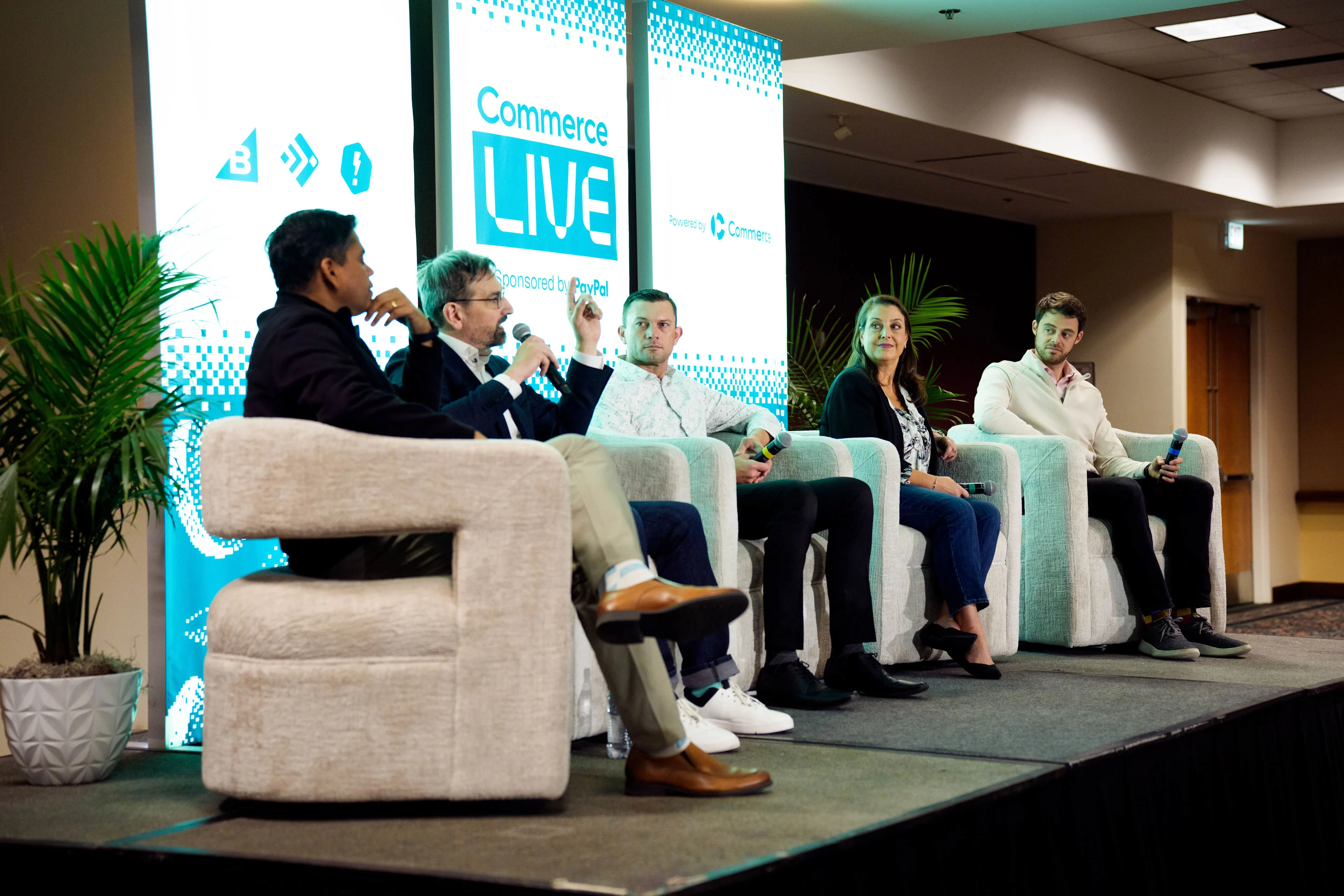
The B2B Trends panelists — from the left: Raj Mohan, Oldcastle; Joe Cicman, Forrester, Travis Powers, Arrow Tool Group; Christy Doshi, Smurfit Westrock; Lance Owide, Commerce
For agency and SI partners in the room, this framing matters. As Forrester’s Cicman explained, the partner relationship in B2B commerce is evolving. His perspective, which he outlined in his Systems-Thinking Mandate session, is that the work process is moving from episodic to continuous, which has direct implications for the operator-partner relationship.
“The good news is that the fundamentals of B2B commerce haven't changed. It's the cadence of the work that is changing,” he said. “For years you launched, you ran campaigns, you optimised them and then rinsed and repeated. What's going to happen very soon is a continuous process that is unbounded by the pace at which humans can work.”
“Go-live, you could say, is the beginning of your learning process. It's not the end. You can still pop champagne at a go-live, but that's just the beginning of the work that you're going to be doing.”
— Joe Cicman, Principal Analyst, Forrester
The old model — projects with clear handoffs, managed services for stability — wasn't designed to support systems that need to improve every day. Cicman was direct about what that means for the partner community specifically: “In the beginning you're probably still going to be running off of a billable hours rate. But over time as you start to deliver improvements from moving work from episodic to continuous, then you'll have a basis for negotiating a new type of deal.”
He advised the B2B leaders in the room that it’s crucial to have a clear division of labour. “Your internal teams will be embedded in the systems they're improving. Your partners will provide analytical distance, systems discipline, and pattern recognition expertise across multiple clients. You'll bring the passion and the understanding of your business and the knowledge of your customers.” Partners who can operate in that model, he said, that are accountable to outcomes, not just deliverables, will increasingly be where the value lives.
The final word: The obvious edge
The businesses that will win in B2B over the next three to five years are not necessarily the ones that moved fastest on AI. They’ll be the ones that cleaned up their data, mapped their processes, built the right partnerships, and created operational foundations strong enough to actually support what comes next.
This is the one Commerce Live 2026 story that might not trend on LinkedIn, but may be the most important one of all.
As Cicman put it, “You're all here trying to figure out how to make your business better. Draw it on the whiteboard. Find someone who cares about the picture as much as you do. Then start.”
The rest will follow.
Commerce Live 2026 brought together B2B and B2C ecommerce executives, agency and technology partners, and industry analysts for two days of conversation about where B2B commerce is heading and how to get there. This post is the fourth in a series of highlights from the event.
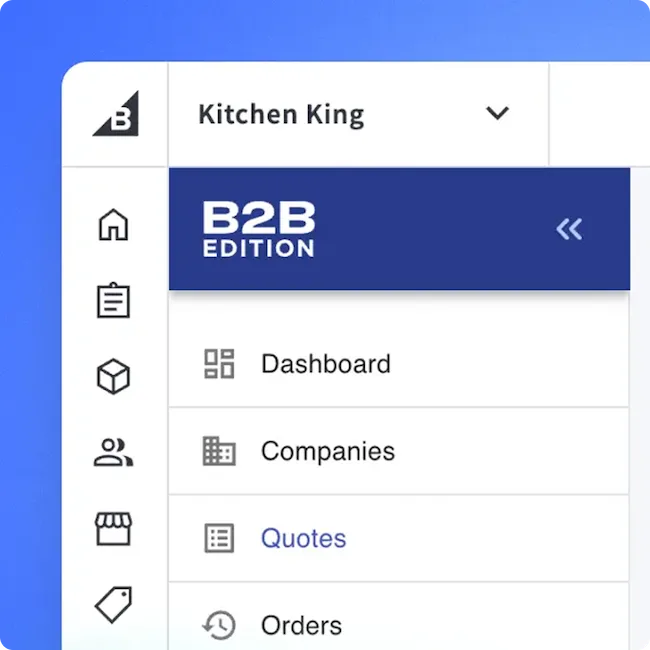
We're serious about B2B.
BigCommerce B2B Edition gives you account management and quoting tools to help your sales team get more orders.