- Start & Build

Product Overview
What you can do with BigCommerce.
Agentic Commerce
 AI-powered solutions for growth.
Design Your Store
Build your store with or without code.
Apps & Integrations
Over 1,200 apps to help you grow.
Migrate to BigCommerce
Switch from Shopify, Woocommerce, Salesforce, Magento, and more.
- Launch Services
Overview
Chart your path to success with specialised services.Implementation Project Management
Experts to ensure you launch on time and under budget.Solution Architecture
Seasoned advisors to help you best design your store.Data Migration & Optimisation
Expertise on a clean and clear path to migrating your data.Enterprise Launch Package
Personal training on how to set up and launch your BigCommerce Store.

Professional Services Blog Series
Get to know our teams and how they support your success in this Q&A series.

The Global B2B Buyer Behavior Report
This in-depth report provides actionable strategies to help you sell more online.
Built for Momentum: How Commerce Is Redefining What an Ecommerce Platform Can Do

Create your store and start selling today.
Create your new website.
See if the BigCommerce platform is a good fit for your business.
No credit card required.

Written by
Anita J. Temple21/05/2026
Key highlights:
Commerce unveiled a broad wave of platform updates across BigCommerce, Feedonomics, and Makeswift, signalling a faster pace of product innovation and a more unified commerce ecosystem.
New capabilities across catalogue management, promotions, checkout, permissions, and multi-language storefronts are designed to help brands operate more efficiently and convert more shoppers.
Major investments in storefront experiences, B2B workflows, payments, and omnichannel syndication aim to help brands scale faster without adding operational complexity.
Commerce introduced a growing suite of AI-powered tools for product discovery, catalogue enrichment, conversational shopping, and back-office automation as agentic commerce reshapes how consumers buy online.
From native Catalyst hosting to AI-driven purchase order processing and agentic checkout integrations, Commerce’s roadmap reflects a long-term vision focused on speed, flexibility, and intelligent automation.
There's a concept in physics that's deceptively simple: momentum is mass times velocity. The bigger the object and the faster it's moving, the more unstoppable it becomes. It's a clean equation, but what does it have to do with ecommerce?
As host Matt Marcotte put it on stage at Commerce Live 2026: “The ‘mass’ is the product that you're going to see today. It will showcase how heads down they [Commerce] have operated to ship product faster than before. The foundation is solid. The platform is broader, smarter, and faster than it ever was. And the velocity? Well, this is a company that rebranded less than a year ago, but instead of stopping to take a breath, they accelerated.”
That's the story Commerce leadership told at Commerce Live. The keynote that kicked off the event, “Commerce Momentum: Product Vision & Roadmap for What’s Next,” delivered more than just an aspirational presentation, it was a demonstration of what happens when years of foundational investment starts compounding.
From checkout speed to agentic commerce and more, here are the highlights — a showcase of what's been built, what's shipping, and what it means for every merchant that runs on Commerce.
Mass: The foundation that makes everything else possible
In the momentum equation, mass comes first. For Commerce, that means a platform brands can actually build on. Jordan Sim, VP of Product Management at Commerce, opened the product keynote with a simple premise: “You spoke, we listened, and we built.” The list of what they delivered for customers across all three brands, BigCommerce, Feedonomics and Makeswift, is substantial.
A catalogue that works the way you do
Two long-requested catalogue improvements are now live. First, merchants can now use the same product name across different products. It’s a small change that delivers tangible operational impact, particularly for brands managing large assortments where naming conventions don't always map neatly to unique SKUs. Second, a new product list filtering system lets merchants build, save, and return to custom filtered views. Filter by category and stock level, save it as a permanent tab, and come back to it every time. As Sim pointed out, “The real value is in saving the setup after you’ve customised it. Once you’ve got it saved in your product list, it’s ready whenever you need it.”
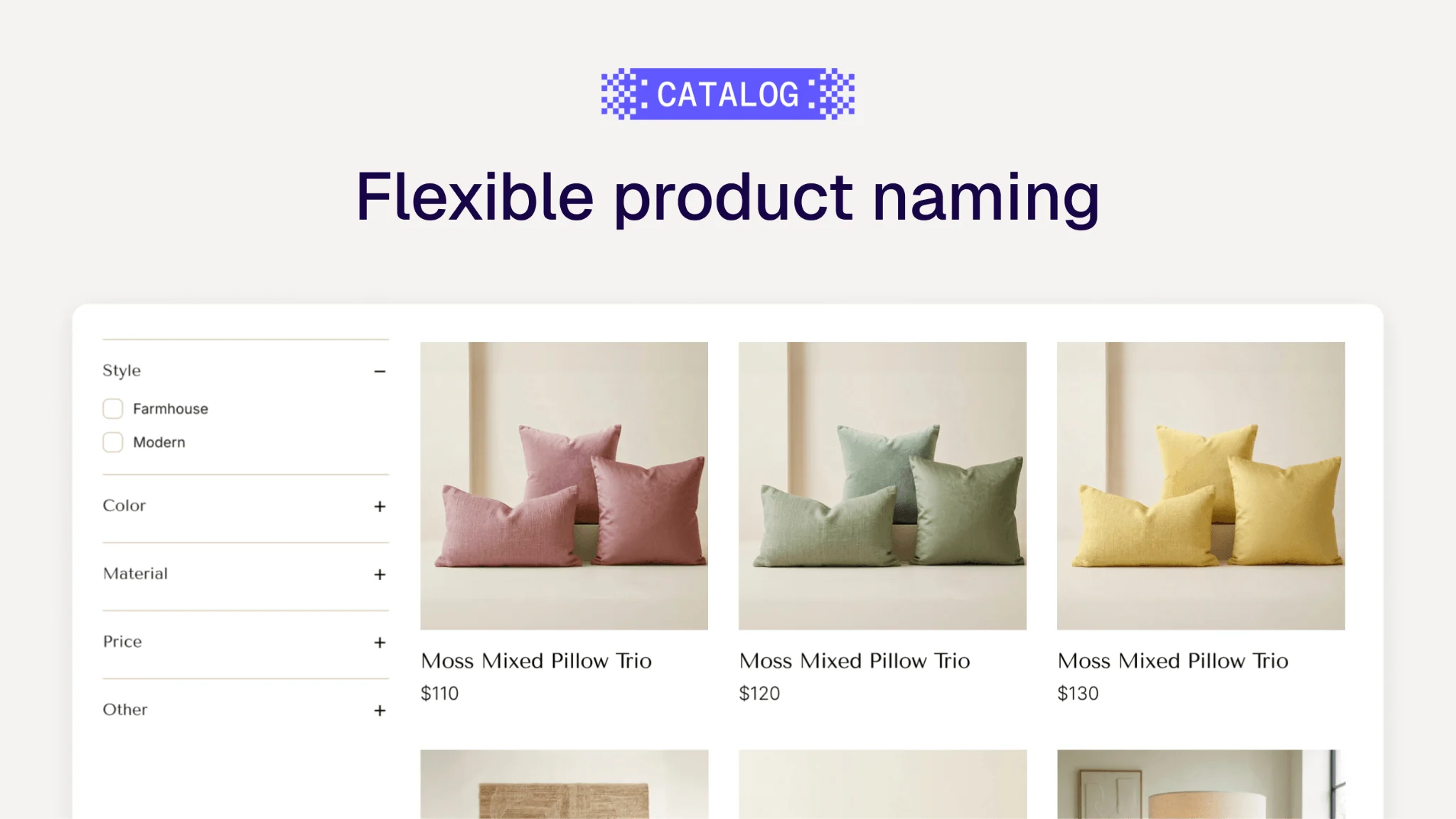
Flexible product naming in action on the BigCommerce platform.
More improvements are coming soon including custom attributes for structured, reusable product data and product templates that let teams pre-define common product details and spin up new listings in a fraction of the time.
Stop losing sales to “out of stock.”
Commerce's new backorders capability is one of those features that pays for itself quickly. It enables brands to continue selling past zero inventory, setting per-variant back order limits — either a fixed cap or unlimited. In beta, merchants who enabled back orders unlocked hundreds of thousands of dollars in revenue that would otherwise have been lost the moment stock hit zero. Phase 2, set to rollout in the second half of 2025, will bring the shopper-facing back order experience to Stencil and Catalyst storefronts.
Four new promotions capabilities.
Commerce shipped four new promotions tools that collectively give merchants far more precision and flexibility:
Discount caps: Set a maximum discount amount on a promotion — for example, 30% off sofas, capped at $100 — so marketing can run campaigns without blowing up margins.
Coupon stacking: Shoppers can now combine multiple coupon codes in a single transaction, with merchants controlling exactly how many codes can be stacked.
Shipping method targeting: Apply discounts to specific shipping methods rather than all of them, removing one of the biggest drivers of checkout abandonment.
Bulk coupon generation: Create up to 10,000 unique, branded coupon codes in seconds — with custom prefixes, suffixes, separators, and code lengths — entirely natively within Commerce.
Additional promotions capabilities designed to help DTC and B2B merchants increase conversion, retention and profits are on the roadmap for 2026.
Checkout speed: 37% faster, zero configuration required.
In January, Commerce reduced checkout load time by a full second — a 37% improvement — and early February data showed approximately a one percentage point lift in conversion. For merchants already on the one-page optimised checkout, that benefit has been running automatically since January 1st. No setup, no configuration. And Commerce isn't stopping there: further checkout speed improvements are actively in progress.
“Sometimes a single second is the difference between a sale and an abandoned cart.”
— Jordan Sim, VP, Product Management, Commerce
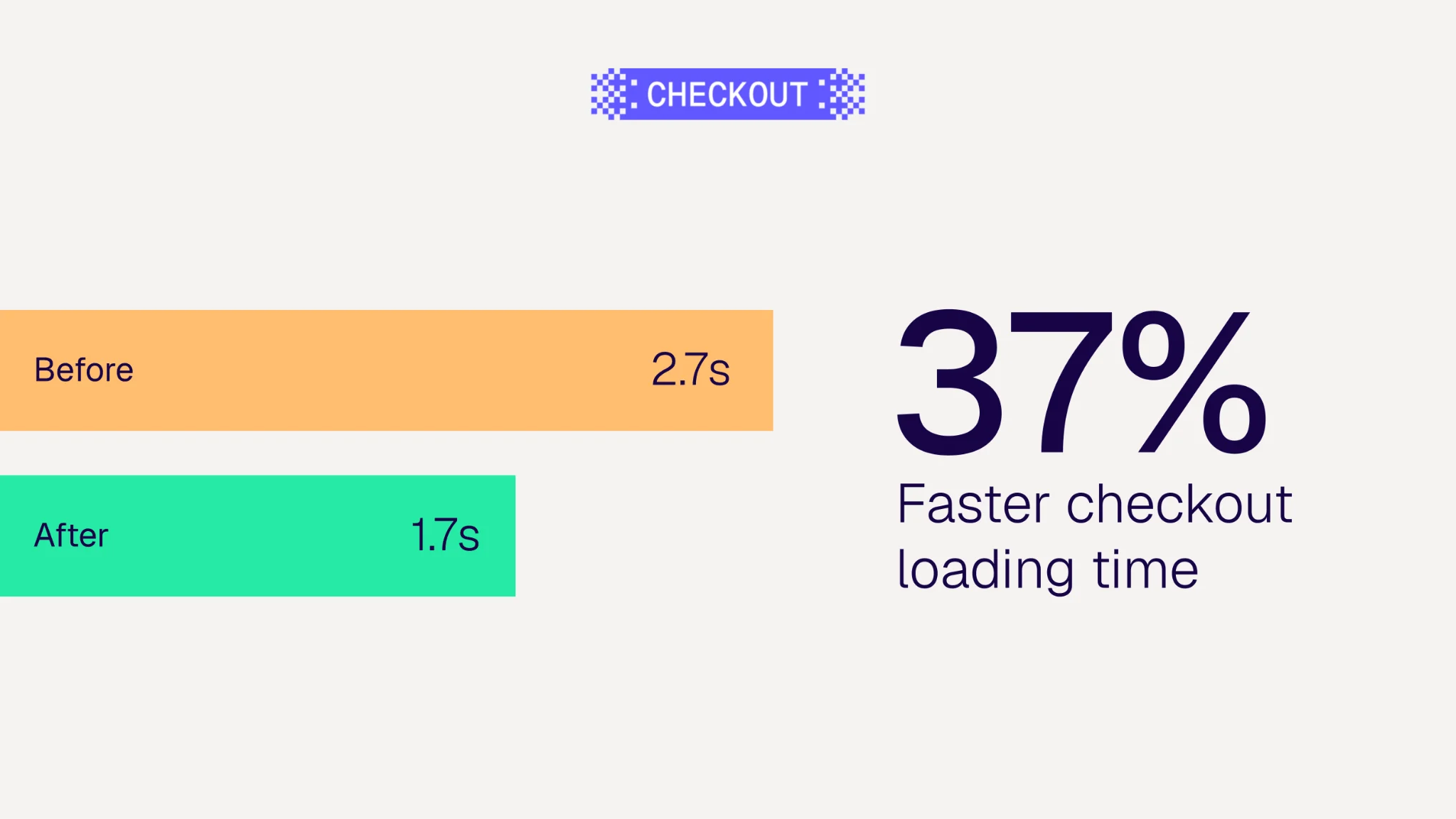
BigCommerce speeds up checkout, improving the customer experience.
Permissions, rebuilt for scale.
Managing user access across a growing team historically meant completing a tedious checklist of individual permissions for every new hire. Commerce's new permissions model changes that. Built around the role-based access control (RBAC) standard that enterprise IT teams have relied on for years, which assigns access to roles, not individuals, it introduces user groups, policy-based permissions, and multi-store scoping. Create a group, assign its policies once, and every new team member added to that group inherits them automatically. As Sim told the audience, “It's clean, it's powerful, it's easy.”
Multi-language on a single storefront.
Merchants are now able to run multiple languages on a single storefront, with language-specific subfolders generated automatically. Long in development, this capability is more than just surface-level translation: it covers products, categories, navigation, checkout, and promotions. The result is a fully localised experience for shoppers, end to end, without the overhead of managing multiple stores.
Velocity: The experience layer that drives growth
With a strong foundation in place, the next imperative is clear: turn visitors into buyers. The experience layer is where that happens. It's what shoppers see, feel, and respond to from the first page load to the final confirmation screen — and where revenue is won or lost. Getting it right means getting three things right simultaneously: the storefront experience that brings a brand to life, the commerce workflows that remove friction at every step, and the channel presence that puts products in front of shoppers wherever they are. That's the combined work of Makeswift, BigCommerce, and Feedonomics. In 2026, all three are moving forward significantly.
Makeswift on Stencil: Visual editing for everyone.
When Commerce shipped Makeswift on Catalyst last year, the response was enthusiastic, however, a consistent question followed, “When can I get this on Stencil?” That answer is now here. Makeswift on Stencil beta is rolling out, bringing multiplayer editing, localisation, scheduled publishing, and true drag-and-drop canvas editing to the vast majority of Commerce merchants.
The rollout is designed for incremental adoption — no forced migrations.
“We didn't want [our customers] to have to think about doing some massive migration in order to start getting the value out of Makeswift.”
— Alan Pledger, Senior Director, Product, Storefronts & Ecosystem, Commerce
Phase 1 lets merchants enable Makeswift on their existing Stencil storefront and begin overriding individual sections without touching the rest. Phase 2, arriving in July, introduces the Widget Template Transformer, which brings existing custom widget templates into Makeswift automatically. Phase 3, which debuts in October, delivers pixel-perfect, one-click automated migration of all Page Builder content into Makeswift.
New handcrafted components are shipping throughout the beta period including an image highlight merchandising component and a scroll-bound video parallax effect — and Pledger hinted that there’s more to come.
AI translations at scale.
Makeswift's AI translation capability, previously operating at the page level, has been expanded to work across an entire site. Merchants can now kick off bulk translation jobs, filter and sort content across all locales, add custom translation instructions at the job or site level, and review changes before they go live. Why is this so important? Well, it means merchants can scale more quickly as rolling out a new language or launching a campaign in multiple markets no longer requires a page-by-page process.
Native hosting for Catalyst.
One friction point has continually surfaced for merchants and partners building on Catalyst, Commerce's headless Next.js storefront framework — the requirement to deploy on Vercel. It added cost, complicated deals, and created a dependency that many merchants didn't want. Commerce's answer is native hosting for Catalyst, in-house Cloudflare infrastructure for deploying Catalyst storefronts, with no additional cost.
“Customers won’t be charged anything for this. It will be included in every Catalyst contract.”
— Alan Pledger, Senior Director, Product, Storefronts & Ecosystem, Commerce
The alpha is live; the beta, including a CLI tool and log retention, arrives at the end of Q2.
B2B: Built for the complexity of business commerce.
B2B isn't a segment Commerce stumbled into, it's where the platform has earned its deepest trust. B2B Edition ARR is growing at nearly 20%, and B2B represents Commerce's number one retention cohort. That kind of loyalty only happens when a platform is genuinely built for the complexity of how businesses actually buy and sell. In the first half of 2026, the product team doubled down on two of the most operationally painful areas in B2B commerce: order automation and pricing.
The Purchase Order Agent, now live in alpha, uses AI to extract data from purchase orders received through any channel, whether uploaded directly or received via email or fax, and validate them against the merchant's catalogue, customer-specific pricing, inventory, and address books, and route them through to checkout. For merchants like AS Colour, a $300 million manufacturer and distributor of blank apparel, this means customers can drag a PO directly into the site and have it processed line by line in seconds. For products that aren't in stock or in catalogue, the agent suggests alternatives so no sale is lost.
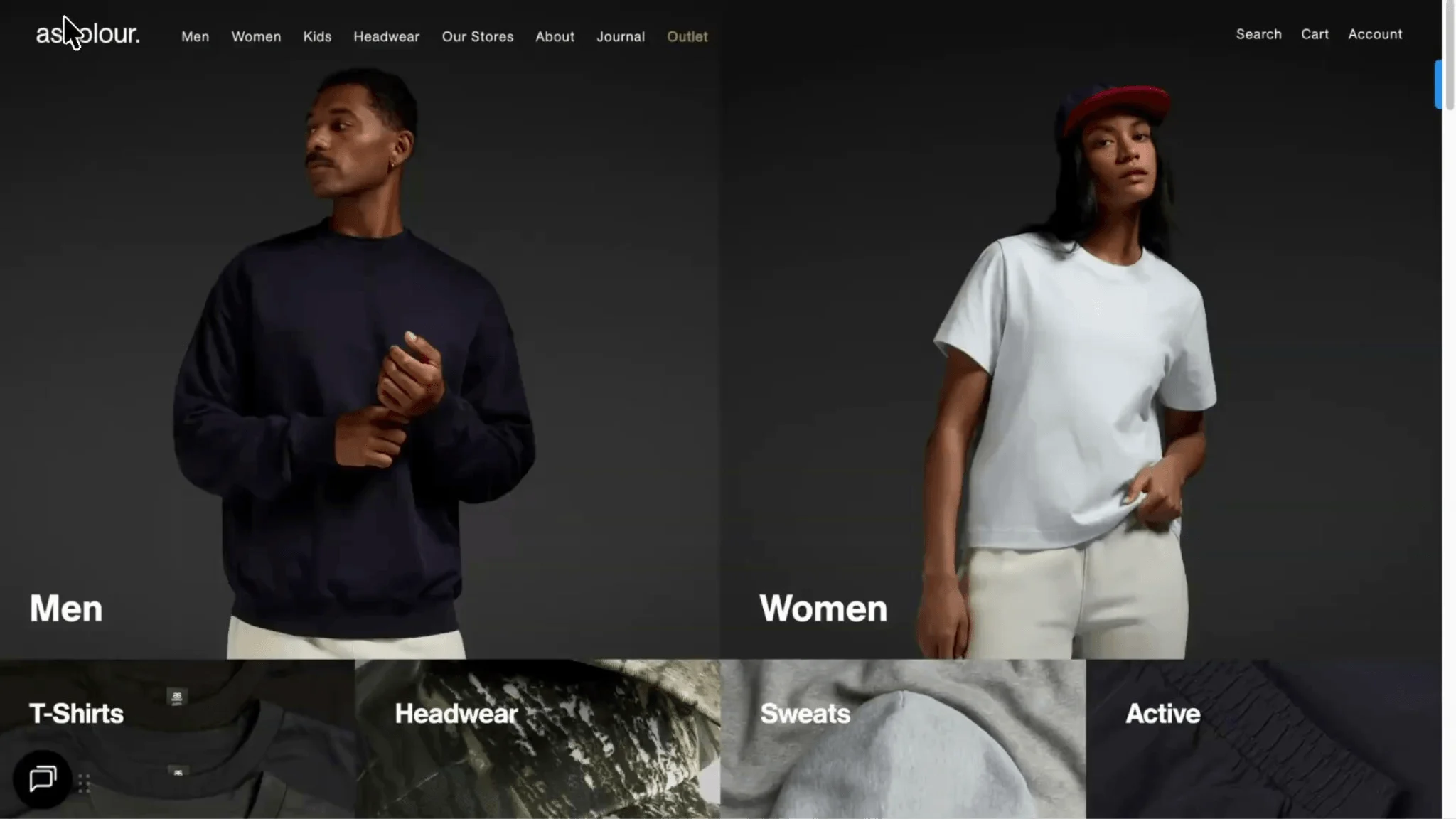
AS Colour website allows buyers to drag a PO onto the site and get it processed in seconds.
On pricing, Commerce has built cascading price lists as a solution to the “price list explosion” problem that plagues complex B2B catalogues that offer contracted, volume, and wholesale pricing across thousands of SKUs. It allows merchants to define a primary price list for contracted pricing, a fallback list for everything else, and then fall back to catalogue pricing as a final default. The beta, launching in June 2026, will offer a lowest price resolution strategy and additional fallback levels in subsequent phases.
Looking to the second half of the year, Commerce's B2B roadmap is centred on unification: one platform, one data model, every storefront. That means storefront GraphQL unification bringing all B2B data into a single API layer; individual React B2B Components for every page of the buyer portal, drag-and-droppable directly within Makeswift; a unified checkout with native B2B fields built in; and unified customer and orders views in the control panel.
BigCommerce Payments and Feedonomics Surface.
Michaela Weber, Vice President of Product, Payments at Commerce presented two major improvements in payments infrastructure introduced in Q1 . BigCommerce Payments, available to US retail plan merchants as of March 30th, is an embedded payment solution that brings the full payments experience — balances, payouts, currency management — directly into the Commerce control panel. It supports credit and debit cards, PayPal, Venmo, Google Pay, Apple Pay, and Buy Now Pay Later out of the box. UK and Europe expansion is planned for Q3.
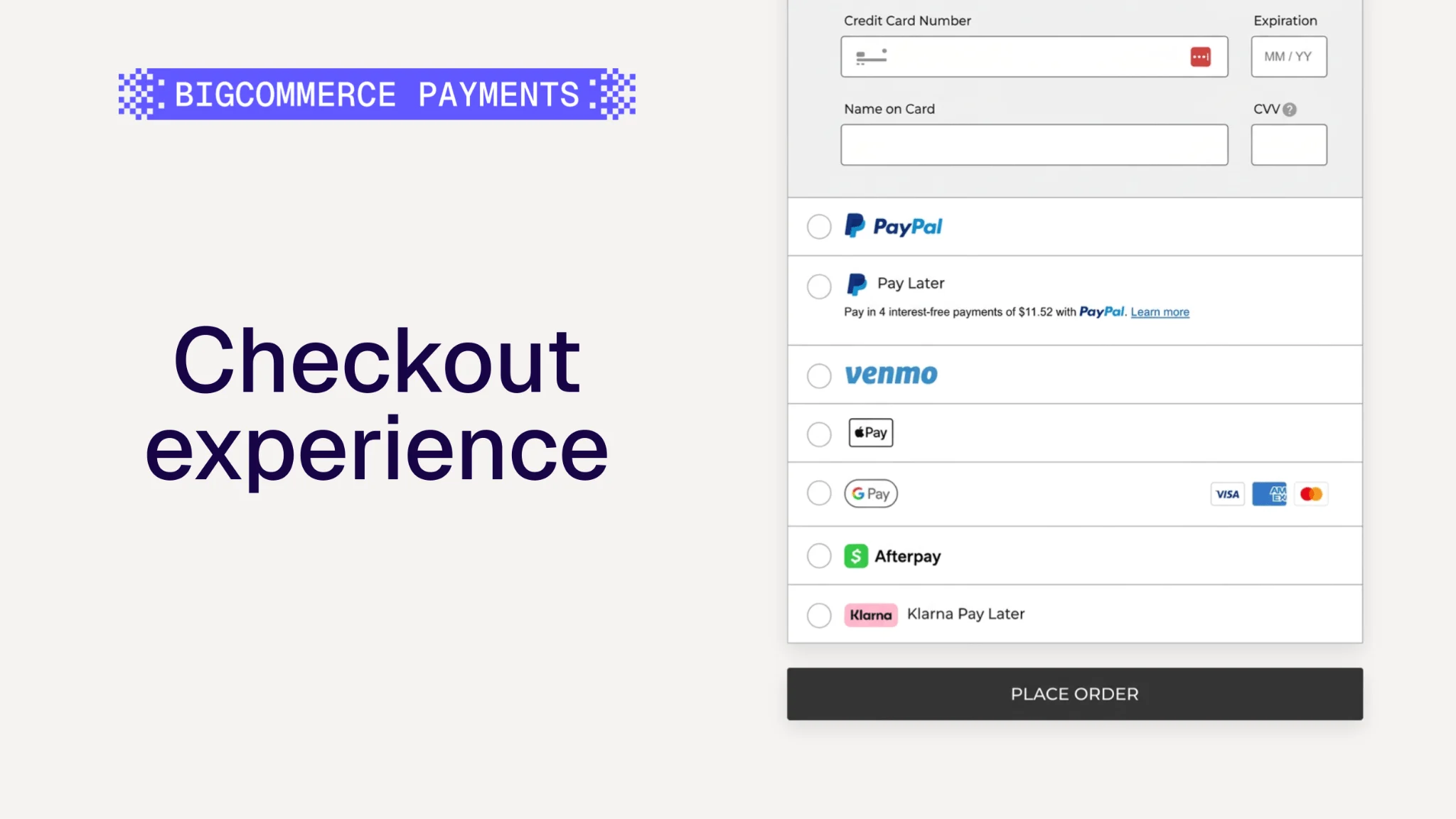
With BigCommerce Payments, shoppers see their preferred payment methods inside an optimised one-page checkout
Weber introduced Feedonomics Surface with a simple truth, “Most merchants assume their products are showing up on their ad channels. But most of the time they're not and nobody is telling them.” Commerce’s solution? Bring enterprise-grade feed management to SMB merchants by giving them a self-service app that connects their BigCommerce catalogue to Google, Meta, Microsoft Ads, TikTok, and Pinterest, keeping product data accurate and in sync automatically. And, based on the results thus far, it’s working.
”BigCommerce merchants using Surface saw approximately 24 percentage points greater GMV growth in November 2025 compared to their peers. And with over 20 million products actively syncing to channels, the scale is real and it's growing fast.’
— Michaela Weber, VP of Product, Payments, Commerce
Surface is free to current customers and available in Channel Manager now.
The agentic era: Commerce built for what's next
The most significant shift Commerce addressed at Commerce Live wasn't a feature, it was a change in how commerce itself works.
“The traditional funnel had four steps: awareness, consideration, evaluation, purchase. And, increasingly, agentic commerce has two: intent and transaction.”
— Sharon Gee, Vice President of Product, AI & Feedonomics, Commerce
As Gee explained it, this compression is already happening. Shoppers are turning to AI to decide and buy without ever leaving a chat interface. For merchants, this creates two urgent imperatives: be discoverable to agents, and use agents to operate more efficiently.
Being found: Enrichment and agentic catalogue exports
“If an agent can't parse your catalogue, it will never surface your products,” Gee told the audience to set the stage for Feedonomics Enrichment. A generative AI service that produces rich, structured, brand-accurate product data at scale, exactly the kind of data that LLMs need to find, recommend, and buy from a merchant. Merchants can select which data to enrich, upload brand and SEO terms, and run enrichment jobs that include an LLM-as-judge step to ensure outputs stay on-brand. It also includes a human review step to keep the merchant in control before anything goes live.
“AI doesn't ask your permission to present your information to answer a user's query. It reads your data and it decides. If your catalogue isn't in the mind of the agent, you're invisible.”
— Sharon Gee, Vice President of Product, AI & Feedonomics, Commerce
Further supporting this new shift is Feedonomics Agentic Catalogue Exports. It is designed to handle the distribution layer, taking that aforementioned enriched catalogue and exporting it to the specific schemas required by each agentic surface. Google AI surfaces require Universal Commerce Protocol. OpenAI, Perplexity, Co-pilot, PayPal, and Amazon Shop Direct each have their own specifications. The basic idea is that merchants shouldn't have to build a new integration every time a new surface appears — instead, Commerce can handle that layer.
Being purchased: PayPal StoreSync and Agentic Checkout Kit.
At this juncture in commerce, discovery without purchase is just advertising. To eliminate some of the factors that prevent the purchase, Commerce has built two paths for completing transactions, both which originate in agentic surfaces.
PayPal StoreSync, announced at Commerce Live, is currently available to BigCommerce customers. The premise is simple: install the app and your catalogue becomes available to PayPal, which syndicates it to Perplexity, Co-pilot, Meta, and, soon, Google. When a shopper places an order inside any of those surfaces, it lands directly in BigCommerce. So, while discovery happens inside the AI channel, fulfilment runs through your own system, ensuring the customer relationship is yours to keep.
For merchants on other platforms, Feedonomics Agentic Checkout Kit connects the components that need to work together — catalogue, inventory, payments, shipping, tax, orders — to create a bridge between any agentic surface and a merchant's existing commerce stack. For example, PacSun, can now make their products discoverable and purchasable on agentic channels without retooling their entire tech stack.
Commerce is also working alongside Google to bring UCP-powered shopping experiences to commerce brands, starting with Agentic Checkout Kit with the goal of enabling shoppers to discover and buy products directly within Google surfaces like AI Mode and the Gemini app.
Running smarter: Conversational Search, MCP, and Companion
Conversational Search, now in closed beta for BigCommerce merchants, moves beyond just finding keywords that match products to understanding shopper intent. So, when a shopper searches for “home decor in a neutral colour,” they get back cushions, rugs, and vases that fit the aesthetic, not just items that contain those words. When the same shopper shifts the search to “loft style chairs,” the experience doesn't reset. ‘It remains consistent,’ Gee explains, returning leather, browns and materials that belong in that space.
“Conversational search creates a cohesive, design-led experience that mirrors how customers actually think and shop.”
— Sharon Gee, Vice President of Product, AI & Feedonomics, Commerce
BigCommerce MCP, available as of Commerce Live, takes things even further. It enables shoppers to interact with an AI Advisor directly on the storefront — describing what they're looking for, receiving narrowed recommendations, and completing a purchase all within a single conversation. For partners, BigCommerce MCP also exposes tools to the broader app ecosystem, enabling the next generation of agentic commerce experiences.
Recently launched to support BigCommerce customers running back of house operations, is the BigCommerce Companion. An AI assistant that’s embedded directly in the control panel, it already knows the context of wherever an operator is in the platform. They can ask it to pull a report, build a custom dashboard, or run a Bulk AI Edit across thousands of product titles and descriptions, and it will execute the request. Gee explained it this way, “Most tools give you the information and leave the work to you. But Companion acts. By doing so it effectively collapses the gap between thinking about a task and completing it.”
“Most merchants don't have 10 products, they have hundreds, thousands — sometimes millions. And across those catalogues, the gaps are everywhere: missing attributes, inconsistent descriptions, titles that may have made sense two years ago. And fixing these manually is a huge pain and a project that never ends.”
— Sharon Gee, Vice President of Product, AI & Feedonomics, Commerce
The final word: Momentum, delivered
What the leaders of Commerce shared on stage during the keynote wasn't a collection of isolated features across its sub-brands. It was a cohesive, thoughtful product vision and roadmap that reinforced Commerce as a unified platform. One in which every layer reinforces the next: enriched data feeds discovery, discovery connects to checkout, storefront experiences convert, and intelligent tools help merchants operate at a scale that wasn't previously accessible to most.
As Matt Marcotte so eloquently stated, “Today is about understanding that momentum — where it came from, where it's going, and how everyone in this room is a part of it.”
The mass is the foundation. Catalogue, checkout, promotions, permissions, multi-language, everything a merchant needs on the backend to deliver modern commerce. The velocity is the experience layer. The storefronts, B2B workflows, payments, channel syndication, and agentic commerce that support merchants on the frontend and improve the customer experience. Combined, they produce something that's genuinely hard to stop.
According to Commerce CEO, Travis Hess, the company is just getting started. In his welcome speech at Commerce Live he announced, “We are launching more products in the next six months than in the entire history of this company.” Visit commerce.com/momentum to follow along.

Commerce built for momentum.
Get up to speed with new features that drive your business forward — from core capabilities to agentic commerce (and beyond).